
Introduction
The global technology industry in 2026 is being shaped by three powerful forces—artificial intelligence, geopolitics, and semiconductor dominance. At the forefront of this transformation stands NVIDIA, the world’s leading AI chipmaker. As AI demand continues to explode worldwide, Nvidia’s relationship with China has become one of the most important stories in global markets.
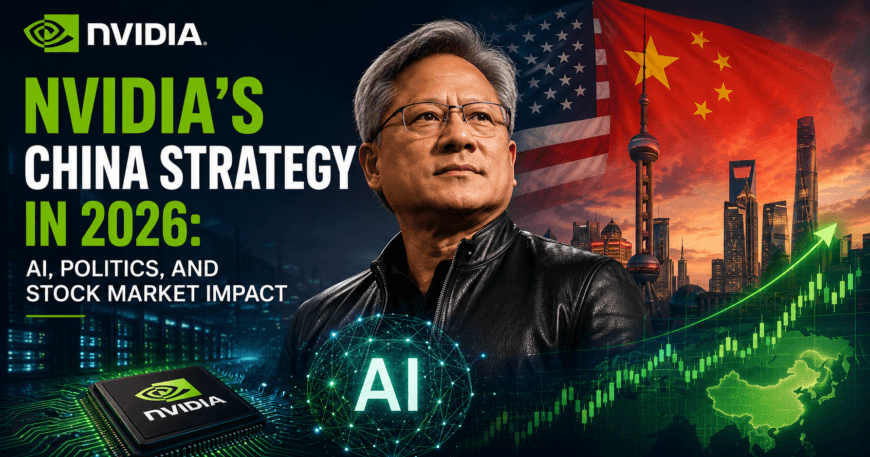
The recent spotlight on Nvidia intensified after Jensen Huang joined Donald Trump’s China trip, triggering strong reactions across financial markets. Investors viewed the development as a potential sign of improving business opportunities between the United States and China, especially in the AI and semiconductor sectors. NVIDIA’s stock rallied sharply as traders anticipated stronger international cooperation, higher AI chip demand, and possible easing of export restrictions.
However, Nvidia’s China strategy is far more complicated than simply selling chips. It involves balancing political pressure from Washington, increasing competition from Chinese technology firms, export control regulations, supply chain security, and long-term AI leadership ambitions.
In 2026, Nvidia is not just a semiconductor company. It has become a symbol of the global AI race.
The Rise of Nvidia in the AI Era
Over the last decade, Nvidia transformed itself from a gaming graphics card company into the backbone of the global AI revolution. Its GPUs are now powering:
- AI data centers
- Machine learning systems
- Autonomous vehicles
- Cloud computing infrastructure
- Robotics
- Generative AI applications
- Scientific research
The rise of generative AI platforms dramatically increased demand for Nvidia’s advanced AI chips. Companies across industries now rely on Nvidia hardware to train and deploy large AI models.
By 2026, Nvidia’s market influence had reached historic levels. Its stock performance has become a major indicator for the broader technology sector. Whenever Nvidia releases earnings, announces new chips, or discusses AI demand, markets worldwide react instantly.
The company’s AI dominance has made it one of the most valuable corporations globally. Investors now view Nvidia as more than a chipmaker — it is considered the infrastructure provider for the future AI economy.
Why China Matters So Much to Nvidia
China remains one of the world’s largest technology and semiconductor markets. Despite political tensions between the United States and China, Chinese companies still require advanced AI chips for the following:
- Cloud services
- AI startups
- Smart manufacturing
- Research labs
- Autonomous driving
- Government-backed AI projects
For Nvidia, China represents both a massive revenue opportunity and a strategic challenge.
Chinese technology firms continue investing heavily in AI development. Large enterprises need high-performance GPUs to remain competitive globally. This creates enormous demand for Nvidia products.
However, U.S. export restrictions have limited Nvidia’s ability to sell its most advanced AI chips to Chinese customers. As a result, Nvidia has been forced to redesign products specifically for the Chinese market while staying compliant with American regulations.
This balancing act defines Nvidia’s China strategy in 2026.
Jensen Huang’s Role in Nvidia’s Global Expansion
Jensen Huang has become one of the most influential leaders in global technology. Known for his long-term vision and strong understanding of AI trends, Huang has positioned Nvidia at the center of the modern AI economy.
Unlike many technology executives, Huang plays an active role in international business discussions. His appearance during Trump’s China-related meetings drew enormous attention because markets interpreted it as a sign of strategic importance.
Investors believe Huang’s involvement indicates Nvidia’s commitment to maintaining access to China despite growing political tensions.
Huang has repeatedly emphasized that AI innovation should continue globally. He also understands that China’s technology ecosystem remains too important for Nvidia to ignore completely.
His leadership style combines technological ambition with geopolitical awareness, making him one of the most closely watched executives in financial markets.
The Political Battle Over AI Chips
Artificial intelligence is now considered a matter of national security. Governments worldwide view advanced semiconductors as strategic assets similar to oil or defense technology.
The United States has imposed multiple export restrictions aimed at limiting China’s access to high-end AI chips. Officials argue that advanced AI hardware could strengthen China’s military and surveillance capabilities.
These restrictions directly affected Nvidia because many of its most powerful chips became restricted for Chinese sales.
As a response, Nvidia created modified chips for China that comply with export rules while still serving commercial AI needs.
This political environment creates uncertainty for Nvidia investors because future regulations could impact the following:
- Revenue growth
- International expansion
- Supply chain operations
- AI market share
- Long-term profitability
The company must continuously adapt to changing government policies while protecting its business interests.
Nvidia’s Customized China Strategy
Nvidia’s strategy for China in 2026 focuses on controlled participation rather than aggressive expansion. Instead of abandoning the Chinese market completely, Nvidia has adopted several strategic approaches.
Developing China-Compliant AI Chips
NVIDIA introduced modified AI processors specifically designed to comply with U.S. export regulations. These chips offer reduced performance compared to flagship models but still support AI workloads.
This allows Nvidia to maintain business relationships in China while avoiding direct violations of export rules.
Strengthening Software Ecosystems
NVIDIA’s CUDA software platform remains a major competitive advantage. Even if hardware restrictions exist, developers continue building AI systems around Nvidia’s software ecosystem.
This creates long-term dependency on Nvidia technology.
Focusing on Enterprise AI
Rather than targeting consumer electronics, Nvidia is increasingly focused on enterprise-level AI infrastructure, including the following:
- AI cloud computing
- Smart factories
- Industrial automation
- Research institutions
These sectors continue showing strong demand in China.
Managing Political Relationships Carefully
NVIDIA avoids directly entering political conflicts. The company positions itself as a technology provider rather than a geopolitical actor.
This neutral approach helps Nvidia maintain relationships with both American regulators and Chinese customers.
Stock Market Reaction to Nvidia’s China News
Whenever news emerges regarding Nvidia and China, global stock markets react quickly. Investors understand that China plays a major role in Nvidia’s growth potential.
When reports surfaced about Jensen Huang’s involvement in Trump’s China-related discussions, Nvidia shares rallied because markets expected the following:
- Possible easing of restrictions
- Improved diplomatic communication
- Continued AI chip demand
- Higher international revenues
Technology stocks across semiconductor sectors also moved higher.
The market reaction highlights how closely AI investing is now connected with geopolitics. Semiconductor stocks no longer move based only on earnings or innovation. Political developments also shape valuations.
In 2026, Nvidia’s stock performance reflects both technological leadership and geopolitical expectations.
The AI Infrastructure Boom
One of the biggest reasons behind Nvidia’s continued growth is the global AI infrastructure boom.
Companies worldwide are racing to build AI capabilities. Governments, cloud providers, banks, healthcare firms, and manufacturers all require AI computing power.
This has created massive demand for:
- GPU clusters
- AI servers
- Data center expansion
- Machine learning infrastructure
- High-speed networking systems
NVIDIA remains the leader in supplying these technologies.
Even with export restrictions, worldwide AI demand remains extremely strong. This allows Nvidia to continue growing despite geopolitical challenges.
The AI infrastructure race is expected to continue for many years, providing long-term support for Nvidia’s business model.
Competition From Chinese AI Chipmakers
While Nvidia remains dominant globally, Chinese companies are rapidly investing in domestic semiconductor development.
Chinese technology firms are trying to reduce dependence on foreign AI hardware by developing local alternatives.
Major areas of focus include:
- AI accelerators
- GPU architecture
- Semiconductor manufacturing
- AI cloud infrastructure
Although Chinese competitors still trail Nvidia in advanced AI capabilities, government support could accelerate their progress over time.
This creates long-term competitive pressure for Nvidia.
However, Nvidia still maintains major advantages in the following:
- Software ecosystems
- Developer support
- AI optimization
- Global partnerships
- Research leadership
For now, Nvidia continues to lead the global AI hardware market comfortably.
Risks Nvidia Faces in 2026
Despite its strong position, Nvidia still faces several major risks.
Geopolitical Risks
Escalating tensions between the United States and China could lead to stricter export controls.
Valuation Concerns
NVIDIA’s rapid stock rally has increased concerns about high market valuations. Some analysts believe expectations may already be extremely optimistic.
Supply Chain Risks
Semiconductor manufacturing remains highly dependent on global supply chains. Disruptions could impact production capacity.
Rising Competition
Companies like AMD, Intel, and emerging Chinese firms are aggressively investing in AI chips.
Regulatory Challenges
Governments worldwide may introduce stricter AI regulations affecting technology companies.
What Nvidia Means for Global Investors
Nvidia has become one of the most important companies for global investors because it represents multiple high-growth trends simultaneously.
- Artificial intelligence
- Cloud computing
- Automation
- Robotics
- Semiconductor innovation
- Data center expansion
For many investors, Nvidia is viewed as the backbone of the AI economy.
Its stock movements often influence broader market sentiment, especially in technology sectors.
Indian investors are also closely following Nvidia because AI adoption is growing rapidly in India. Many Indian technology firms depend on AI infrastructure powered by Nvidia systems.
As global AI investments rise, Nvidia’s future performance may continue impacting worldwide stock markets.
Nvidia and the Future of AI Politics
The relationship between AI and politics will likely become even more important over the next decade.
Countries increasingly view AI leadership as essential for economic growth, military capability, and global influence.
This means companies like Nvidia will continue operating at the intersection of the following:
- Technology
- National security
- International trade
- Economic competition
NVIDIA’s ability to navigate these challenges may determine how successfully it maintains global AI leadership.
The company’s China strategy in 2026 reflects a broader shift happening across the technology industry — businesses must now manage both innovation and geopolitics simultaneously.
Conclusion
NVIDIA’s China strategy in 2026 highlights the growing connection between artificial intelligence, politics, and global financial markets. As AI demand continues to surge worldwide, Nvidia remains at the center of the technological revolution.
Jensen Huang’s participation in high-profile political discussions reinforced the importance of NVIDIA’s international position. Investors interpreted the move as a sign that AI chip diplomacy is becoming a major factor in global markets.
While challenges remain, including export restrictions and geopolitical tensions, Nvidia continues benefiting from enormous AI demand and strong technological leadership.
The future of AI will not depend only on innovation. It will also depend on international relations, semiconductor policies, and strategic global partnerships.
And in that future, Nvidia is expected to remain one of the most influential companies in the world.
FAQs
Why is Nvidia important in the AI industry?
NVIDIA develops advanced GPUs that power artificial intelligence systems, machine learning models, cloud computing, and data centers worldwide.
Why did Nvidia stock rally recently?
Nvidia’s stock rallied after optimism grew around U.S.-China relations and Jensen Huang’s involvement in China-related political discussions.
Why is China important for Nvidia?
China is one of the largest AI and semiconductor markets globally, creating strong demand for Nvidia’s AI chips.
Who is Jensen Huang?
Jensen Huang is the founder and CEO of Nvidia and one of the most influential leaders in the AI technology sector.
What are AI chips?
AI chips are specialized processors designed to handle artificial intelligence and machine learning workloads efficiently.
What challenges does Nvidia face in China?
Nvidia faces export restrictions, geopolitical tensions, regulatory uncertainty, and increasing competition from Chinese chipmakers.
What is Nvidia’s China strategy in 2026?
NVIDIA focuses on compliant AI chips, software ecosystems, enterprise AI solutions, and balanced international relationships.
How do U.S. export controls affect NVIDIA?
Export restrictions limit Nvidia’s ability to sell its most advanced AI chips to Chinese customers.
Is NVIDIA still leading the AI chip market?
Yes, NVIDIA remains the global leader in AI GPUs and AI infrastructure technology.
Why do investors closely watch Nvidia?
NVIDIA is considered one of the most important AI companies, and its performance often influences broader technology markets.
Can Chinese companies replace Nvidia?
Chinese firms are investing heavily in AI chips, but Nvidia still maintains strong technological and software advantages.
What industries use Nvidia AI chips?
Industries include cloud computing, robotics, healthcare, finance, automotive, manufacturing, and research.
How does AI demand support Nvidia’s growth?
Growing AI adoption worldwide increases demand for GPUs, servers, and AI infrastructure powered by Nvidia technology.
What role does politics play in semiconductor markets?
Governments increasingly view semiconductors and AI technology as strategic national assets.
What is the future outlook for Nvidia?
Most analysts expect Nvidia to remain a dominant player in AI infrastructure and semiconductor innovation for years to come.