
Introduction
Before entering a trade, most traders have a price in mind. The harder questions often come afterwards: Where should you book a profit? When should you exit if the price moves against you? What happens if the market reaches either level while you are still deciding?
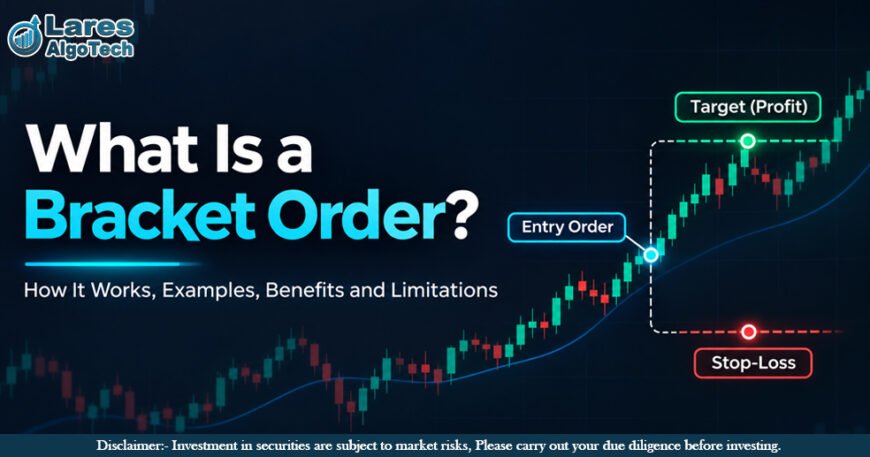
A bracket order brings these decisions into one connected setup. It links an entry order with a profit target and a stop-loss, allowing traders to define their intended exits before the position opens.
However, setting three prices does not make a trade risk-free. Orders still depend on market liquidity, execution conditions, and the broker’s systems. Understanding those details helps you use the feature with more realistic expectations.
This guide explains the bracket order meaning, its components, how execution works, and the benefits and limitations you should understand before using it.
What Is a Bracket Order?
A bracket order is a linked order arrangement that combines an entry order with two exit instructions: a profit target and a stop-loss.
The entry opens the position. The target is intended to close it after a favourable price movement, while the stop-loss provides an exit instruction if the market moves against the trade.
In a typical setup, the exit orders become active after the entry executes. They are connected through a mechanism called One Cancels the Other, or OCO. When one exit executes, the system is designed to cancel the remaining exit.
For example, a trader might plan to buy a share at ₹500, take a profit at ₹515 and place a stop-loss trigger at ₹492. These exit levels sit on either side of the entry price, creating the “bracket.”
The precise arrangement varies across brokers. Supported entry types, stop-loss types, order validity and partial-fill handling may differ. Therefore, understanding the concept is only the first step; you also need to understand your platform’s implementation.
The Three Main Components of a Bracket Order
A traditional bracket order has three connected parts. Each performs a separate function.
Entry Order
The entry order opens the position.
For a buy trade, it purchases the selected quantity. For an eligible short-selling trade, it sells first, with the intention of buying back later.
Some platforms support limit entries, while others may offer additional choices. A limit entry controls the acceptable execution price but does not guarantee that the order will fill.
If the entry remains unexecuted, there is no position to close. The linked exits should remain dependent on the entry according to the platform’s rules.
Profit-Target Order
The target specifies the favourable level at which the trader intends to exit.
For a long position, the target is above the entry price. For a short position, it is below the entry.
A target is an instruction, not a prediction. Setting it does not make the market more likely to reach that level.
Stop-Loss Order
The stop-loss provides an exit instruction when the market moves against the position.
For a long trade, the stop is below the entry. For a short trade, it is above.
Its execution depends on the supported order type. A stop-market order and a stop-limit order behave differently, particularly during fast price movements.
How Does a Bracket Order Work?
Understanding the sequence matters because submitting an order and executing a trade are different events.
Step 1: Enter the Trade Details
Select an eligible instrument, choose the buy or sell direction, and enter the quantity. Then provide the entry, target and stop-loss details.
Check how the platform expects these values. One interface may require absolute prices, while another may ask for a distance in points or a percentage.
Step 2: Submit the Order Setup
The broker checks the instructions against its rules, available funds and applicable restrictions.
Submission does not automatically mean acceptance. An order may be rejected because of insufficient funds, invalid price values or product restrictions.
Step 3: Confirm Entry Execution
Once accepted, the entry may execute fully, partially or remain pending.
A limit order placed at ₹500 will not necessarily fill simply because the market briefly displays that price. Available quantity and queue priority also matter.
Step 4: Verify the Linked Exits
After the entry fills, check that the target and stop-loss instructions are active for the appropriate quantity.
Partial entries require particular attention because platforms may manage their linked exits differently.
Step 5: Confirm the Exit and Cancellation
When one exit executes, the OCO mechanism is intended to cancel the other.
Finally, check the position book and order book. A completed trade should be confirmed through actual execution and cancellation statuses.
Bracket Order Example: A Buy Trade
Assume a trader places a hypothetical buy bracket order with these details:
| Component | Value |
| Quantity | 100 shares |
| Entry price | ₹500 |
| Target price | ₹515 |
| Stop-loss trigger | ₹492 |
Suppose all 100 shares are purchased at ₹500.
If the Target Executes
If all shares are sold at ₹515, the gross profit is:
(₹515 − ₹500) × 100 = ₹1,500
After the target exit executes, the system is designed to cancel the remaining stop-loss order.
If the Stop-Loss Exit Executes at ₹492
If the position closes entirely at ₹492, the gross loss is:
(₹500 − ₹492) × 100 = ₹800
The target order should then be cancelled through the linked-order mechanism.
However, ₹800 is the loss under the assumed execution prices. It is not a guaranteed maximum loss.
If the stop triggers at ₹492 but the actual market exit occurs at ₹490, the gross loss becomes:
(₹500 − ₹490) × 100 = ₹1,000
All these calculations exclude brokerage and other applicable charges.
Bracket Order Example: A Short Trade
A bracket order can also be structured around an eligible short position where the broker supports it.
Consider this hypothetical intraday example:
| Component | Value |
| Quantity | 100 shares |
| Sell entry | ₹800 |
| Buyback target | ₹780 |
| Stop-loss trigger | ₹810 |
Here, the trader sells first and needs to buy back the shares to close the position.
If all shares are bought back at ₹780, the gross profit is:
(₹800 − ₹780) × 100 = ₹2,000
If all shares are bought back at ₹810, the gross loss is:
(₹810 − ₹800) × 100 = ₹1,000
The exit directions are reversed compared with a buy trade: the profit target is lower than the entry, and the stop-loss is higher.
These figures assume complete execution at the stated prices. Actual results depend on fills, charges and the product’s rules. An intraday short position should not be assumed eligible for overnight holding.
Understanding Planned Risk and Reward
A bracket order makes it easier to see the relationship between entry, target and stop-loss before submitting a trade.
Using the earlier buy example:
- Planned price risk per share: ₹500 − ₹492 = ₹8
- Planned reward per share: ₹515 − ₹500 = ₹15
- Planned risk-to-reward ratio: 1:1.875, or approximately 1:1.88
This means the intended reward is about 1.88 times the planned price risk.
However, the ratio says nothing about how likely either outcome is. A distant target may offer an attractive ratio while being difficult to reach.
Quantity also matters. An ₹8 planned price risk represents ₹800 for 100 shares, but ₹4,000 for 500 shares, before charges and execution differences.
The bracket defines price instructions. It does not decide an appropriate position size for you.
Benefits of Bracket Orders
Bracket orders can improve how a trading plan is organised and submitted.
Exit Decisions Are Made Earlier
Setting a target and stop-loss before entering encourages traders to consider both outcomes.
This can reduce the tendency to enter first and postpone difficult decisions until the position is already losing money.
Fewer Separate Order Actions
A linked setup can reduce the number of manual steps required to establish exit instructions.
Without it, a trader may need to enter the position and then place and manage separate closing orders.
Support for a Consistent Process
Predefined instructions can help traders follow a repeatable approach instead of making every exit decision during a rapid price movement.
This benefit depends on using sensible settings and resisting unnecessary changes.
Clearer Trade Reviews
Recorded entry, target and stop-loss levels make it easier to compare the original plan with the actual outcome.
A review can examine whether the issue came from the trade idea, quantity, order settings or execution conditions.
These benefits concern organisation and execution. They do not establish that the underlying strategy is profitable.
Limitations and Risks of Bracket Orders
The most important limitations become visible when market behaviour differs from the neat examples shown in tutorials.
A Stop-Loss Does Not Guarantee Its Trigger Price
A stop-loss trigger activates an instruction. It does not guarantee a fill at that exact price.
Where supported, a stop-market order becomes a market order after triggering. It may execute at a worse price when available liquidity is limited or prices move quickly.
A stop-limit order becomes a limit order after triggering. It controls the acceptable execution price but can remain unfilled if the market moves beyond that limit.
Both involve a trade-off that should be understood before placing the order.
A Target Is Not a Guaranteed Fill
A price appearing on a chart does not prove that your entire target order could execute there.
The available buying or selling quantity, your place in the queue and the order type influence the result.
A target can fill partially while leaving part of the position open.
Gaps and Thin Liquidity Can Affect Exits
Prices do not always move smoothly between adjacent levels.
A sudden announcement, sharp order imbalance or shortage of available counterparties can move the market through the planned stop level. Trading halts or price restrictions may also prevent an immediate exit.
OCO Cancellation Is a Separate Process
The intended sequence is straightforward: one exit executes and the other is cancelled.
In practice, execution and cancellation are separate operations. During rapid reversals, both exits may potentially execute before cancellation completes, depending on the system. This can create an unintended position.
Technical Problems Still Matter
Rejected child orders, delayed updates and platform disruptions can affect trade management.
A linked order feature reduces certain manual tasks, but traders still need to monitor order status and know the broker’s procedure for unresolved positions.
Bracket Order vs Cover Order
The main difference between a traditional bracket order and a cover order is the linked profit target.
A cover order combines an entry with a compulsory stop-loss. A bracket order includes those components and adds a target linked to the stop-loss through OCO.
| Feature | Traditional bracket order | Traditional cover order |
| Entry order | Included | Included |
| Linked stop-loss | Included | Included |
| Linked profit target | Included | Generally absent |
| Exit arrangement | Target and stop-loss connected through OCO | Protective stop-loss linked to entry |
| Profit-taking | Can follow the predefined target | Usually requires a separate exit action |
| Product availability | Depends on broker rules | Depends on broker rules |
When comparing bracket order vs cover order, avoid choosing solely on the number of available features.
Check which order types are supported, how exits are modified and what happens after partial execution or a manual close.
Neither order name should be treated as a promise of additional leverage. Margin requirements depend on the applicable rules and broker controls.
What to Check Before Placing a Bracket Order
A short review before submission can prevent avoidable mistakes.
Confirm the instrument and product. Similar instrument names, different expiries and incorrect product selections can lead to unintended exposure.
Check the quantity. Calculate the rupee impact of the planned stop distance instead of looking only at the price difference.
Review all price fields. Confirm that the target and stop-loss are on the correct sides of the entry. Check whether the platform expects prices, points or percentages.
Understand the stop instruction. Where separate trigger and limit prices are required, understand what each does.
Check validity and closing rules. Review applicable expiry, square-off and modification conditions.
Verify execution afterwards. Confirm the filled entry quantity, active exit quantities and any rejected instructions.
After closing the trade, inspect both pending orders and remaining positions. A manual exit should always be followed by a check of the associated instructions.
Are Bracket Orders Available With Every Broker?
Bracket orders are not available in the same form across every broker or trading platform.
Some brokers have discontinued traditional bracket orders. Others offer related functionality through linked stop-loss and target features, conditional orders or differently named products.
Similar labels do not necessarily mean identical behaviour.
Before using a feature, check:
- Supported instruments and market segments.
- Eligible intraday or delivery products.
- Entry and exit order types.
- Handling of partial fills.
- Modification and cancellation rules.
- Order validity.
- Treatment of manual exits and product conversions.
A tutorial recorded for an older interface may no longer describe the current system accurately.
Check the broker’s current documentation and order window. Avoid assuming that an overnight conditional-exit feature follows the same rules as a traditional intraday bracket order.
Common Mistakes to Avoid
One common mistake is treating the calculated stop-loss amount as the most that can possibly be lost. Slippage, unfilled orders and charges can change the result.
Another is increasing quantity because a stop-loss is attached. A protective instruction does not make an oversized position manageable.
Traders can also confuse a triggered order with an executed order. The trigger condition may have occurred while the actual exit remains pending.
Changing the stop repeatedly deserves attention too. Moving it further away increases exposure and changes the original plan.
Finally, closing a position manually without checking its linked exits can leave unwanted pending instructions. Always verify what remains active after any intervention.
FAQ’s
What is a bracket order in simple words?
A bracket order links a trade entry with a profit target and a stop-loss. The two exits are typically connected so that executing one leads to cancellation of the other.
Does a bracket order guarantee a profit?
No. The target may never be reached, and the trade can lose money. The feature organises instructions; it does not predict market direction.
What happens if the entry order does not execute?
There is no filled position to close. Linked exit activation depends on the entry and the platform’s rules. Partial entries require additional checks.
Can a bracket order be modified?
Modification depends on the broker, order status and permitted fields. Changes may be restricted after particular stages of execution.
Is a bracket order suitable for overnight positions?
Traditional bracket products are often intraday arrangements. Other linked-exit features may support longer validity. Check the specific product rather than relying on the name.
Does every bracket order include a trailing stop-loss?
No. A trailing stop-loss is an additional feature offered by some platforms. Its availability and adjustment rules vary.
Conclusion
A bracket order helps connect entry planning with predefined exit instructions. Its value comes from making those decisions clearer and reducing some manual order-management steps.
Using it well requires more than selecting three prices. Understand the supported order types, calculate position exposure and verify actual fills. A planned exit level is useful, but the final outcome still depends on how the market and the order system execute the instructions.