
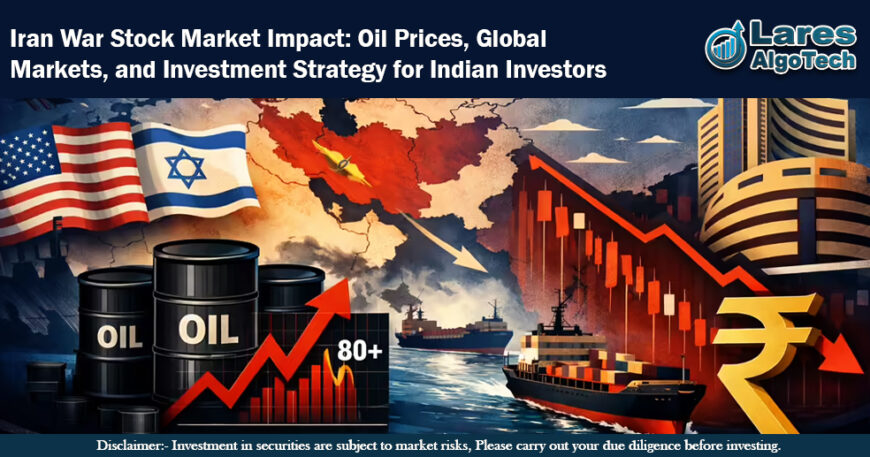
Introduction: Why the Iran War Matters for Global Financial Markets
Geopolitical conflicts have always had a deep influence on global financial markets, and the Iran war stock market impact is no exception. Whenever tensions escalate in the Middle East, global investors closely monitor developments because the region plays a critical role in the world’s energy supply. Wars or conflicts in this region often trigger immediate reactions in commodities, currencies, and stock markets across the globe.
The Middle East controls a significant share of the world’s oil production and export routes. As a result, any military escalation involving Iran raises fears of oil supply disruptions. Financial markets react quickly to these risks, leading to volatility in equities, commodities, and foreign exchange markets. During the recent escalation involving Iran, global markets saw sharp movements. Oil prices surged past $100 per barrel, while stock markets experienced sudden corrections due to rising uncertainty.
The Iran war oil prices surge is one of the most immediate and visible consequences of such geopolitical events. Oil markets are extremely sensitive to supply disruptions, and even the possibility of reduced supply can push prices significantly higher. Since oil is a key input for industries worldwide, rising crude prices can increase production costs, trigger inflation, and reduce corporate profitability.
For investors, the Middle East war stock market impact creates both risks and opportunities. Markets often experience panic selling, increased volatility, and rapid sector rotation. While some sectors such as aviation and logistics suffer from higher fuel costs, others like energy producers and defense companies may benefit.
Indian investors, in particular, must pay close attention to these developments. India imports a large portion of its crude oil requirements, making the economy highly sensitive to global oil price fluctuations. When oil prices rise due to geopolitical tensions like the Iran conflict, it can impact inflation, currency stability, and stock market performance.
Understanding the Iran war impact on the Indian economy helps investors prepare better strategies. Instead of reacting emotionally to market volatility, informed investors analyze macroeconomic trends and adjust their portfolios accordingly.
In the following sections, we will examine how the Iran conflict affects oil prices, global markets, and investment strategies, and what Indian investors should consider during such uncertain times.
Understanding the Iran Conflict: Background and Global Economic Importance
To fully understand the Iran war stock market impact, it is essential to examine the geopolitical and economic importance of Iran in the global energy landscape. Iran occupies a strategically critical position in the Middle East and plays a major role in global oil markets.
Iran is located near the Strait of Hormuz, one of the most important shipping routes in the world. This narrow waterway connects the Persian Gulf to global oil markets and is responsible for transporting approximately 20% of the world’s crude oil supply. Every day, millions of barrels of oil pass through this corridor, making it a vital artery for global energy trade.
Because of this strategic importance, any conflict involving Iran raises serious concerns about disruptions in oil transportation. If tensions escalate or military activity threatens shipping lanes, global oil supply chains can be severely impacted. Even the fear of such disruptions is enough to cause significant volatility in energy markets.
The Iran war oil prices surge is often driven by these supply fears. When markets anticipate potential disruptions in the Strait of Hormuz, traders immediately factor in risk premiums, pushing oil prices higher.
The geopolitical tensions involving Iran are also deeply connected to its relationships with Western powers. Over the years, Iran has faced sanctions, diplomatic conflicts, and military confrontations involving major global powers. These tensions periodically escalate into conflicts that shake global markets.
Military escalation in the region can also impact shipping routes and maritime trade. Oil tankers traveling through the Persian Gulf become vulnerable during conflicts, increasing insurance costs and transport risks. These additional costs ultimately affect oil prices and global supply chains.
The Middle East war stock market impact is therefore not limited to the region alone. Because oil is a global commodity, any disruption in the Middle East quickly spreads across financial markets worldwide.
Investors closely watch developments around Iran because the consequences can ripple through multiple sectors including energy, transportation, manufacturing, and financial markets.
For Indian investors, understanding this geopolitical background is crucial. Since India relies heavily on imported oil, the Iran war impact on the Indian economy can influence inflation, trade balance, currency stability, and overall market sentiment.
In short, Iran’s geopolitical position and control over key energy routes make it one of the most important countries affecting global financial markets.
Immediate Global Market Reaction to the Iran War
Whenever geopolitical conflicts erupt, financial markets react swiftly. The Iran war stock market impact became visible immediately after tensions escalated, triggering volatility across global markets.
Stock markets across Asia, Europe, and the United States experienced sudden declines as investors reacted to rising uncertainty. Geopolitical conflicts increase risk perception, causing investors to reduce exposure to equities and shift capital into safer assets.
This shift in sentiment is commonly referred to as a risk-off environment. During such periods, institutional investors move funds away from high-risk investments like stocks and towards safer alternatives such as government bonds, gold, and reserve currencies.
One of the most noticeable reactions during the conflict was the sharp rise in Iran war oil prices. Oil markets reacted instantly due to concerns that military escalation could disrupt production or transportation in the Persian Gulf region. As oil prices surged, global equity markets came under pressure.
Gold prices also witnessed strong demand during the crisis. Historically, gold has been considered a safe-haven asset during periods of geopolitical instability. As uncertainty increased, investors turned to gold to preserve capital.
Currency markets also experienced fluctuations. The US dollar strengthened as investors sought stability, while emerging market currencies, including the Indian rupee, faced downward pressure.
Institutional investors and hedge funds often adjust their portfolios rapidly during geopolitical events. Large asset managers rebalance portfolios by reducing exposure to volatile sectors and increasing allocations to defensive industries.
Another important aspect of the Middle East war stock market impact is investor psychology. Fear and uncertainty often drive short-term market reactions more than actual economic damage. Markets tend to overreact initially before stabilizing once the situation becomes clearer.
This pattern has been observed in many previous geopolitical conflicts. Initially, markets decline sharply due to uncertainty. Later, once investors assess the real economic consequences, markets gradually recover.
For traders and investors, understanding this psychological aspect of markets is essential. Reacting emotionally to geopolitical news can lead to poor investment decisions.
Instead, disciplined investors focus on long-term fundamentals and evaluate whether market corrections create attractive opportunities.
Why Oil Prices Surge During Middle East Wars
One of the most direct consequences of geopolitical conflicts in the Middle East is the sharp rise in oil prices. The Iran war oil prices surge is driven by multiple economic and geopolitical factors that affect global energy supply.
The Middle East accounts for a significant portion of global oil production. Countries such as Saudi Arabia, Iran, Iraq, and the United Arab Emirates collectively supply a large share of the world’s crude oil. When conflicts arise in this region, markets fear potential disruptions to production or transportation.
Supply disruptions are one of the biggest drivers of oil price spikes. Even if actual production remains unchanged, the mere possibility of supply interruptions can push prices higher.
Another key factor is the Strait of Hormuz, through which a massive portion of global oil shipments pass. If military tensions threaten shipping routes in this area, oil tankers may face delays or increased risk. Insurance costs for shipping rise significantly, and these additional costs get reflected in oil prices.
During major geopolitical events, oil traders often add a risk premium to crude prices. This premium represents the possibility of supply disruptions or production losses.
The Middle East war stock market impact also spreads through the energy markets. When oil prices rise rapidly, industries dependent on fuel face increased operational costs. Airlines, transportation companies, and manufacturing firms experience rising expenses, which can affect profitability.
OPEC production decisions also play an important role during geopolitical crises. If oil-producing countries decide to reduce production or face disruptions due to conflict, global supply can tighten further.
Additionally, speculation in commodity markets can amplify price movements. Traders anticipating shortages may increase buying activity, pushing prices even higher.
For oil-importing nations like India, rising crude prices create economic challenges. Higher energy costs increase inflation, affect trade balances, and put pressure on currencies.
Therefore, the crude oil impact on stock market is significant. Rising oil prices often trigger market corrections in oil-importing economies while benefiting energy producers.
Understanding these dynamics helps investors anticipate market movements during geopolitical crises and prepare investment strategies accordingly.
Why India Is Highly Sensitive to Oil Price Shocks
India is one of the largest consumers of crude oil in the world, but it produces only a small portion of its domestic requirements. As a result, the Iran war impact on the Indian economy is closely linked to fluctuations in global oil prices.
India imports more than 80% of its crude oil needs, making the country highly vulnerable to global energy price shocks. When the Iran war oil prices surge, India’s import bill increases significantly, placing pressure on the overall economy.
One of the most immediate consequences of rising crude prices is inflation. Oil is a critical input for transportation, manufacturing, and electricity generation. When fuel prices increase, the cost of goods and services also rises, pushing inflation higher.
Another major impact is on the trade deficit. India spends billions of dollars annually on crude oil imports. When oil prices rise, the country’s import expenditure increases, widening the trade deficit.
Higher oil imports also put pressure on the Indian rupee. Since oil purchases are made in US dollars, higher oil prices increase the demand for dollars, leading to currency depreciation.
Fiscal pressure is another important consequence. Governments often subsidize fuel prices or adjust tax policies to control inflation. This can strain public finances during prolonged periods of high oil prices.
The crude oil impact on stock market is also visible in India. Rising fuel prices affect corporate profitability, particularly in sectors that rely heavily on transportation and logistics.
Industries such as aviation, chemicals, and manufacturing often experience higher costs when oil prices rise sharply.
For investors, understanding this connection is crucial. Monitoring global oil prices provides valuable insights into the potential direction of inflation, interest rates, and stock market performance in India.
Impact on the Indian Stock Market (Sensex & Nifty)
The Iran war stock market impact is quickly reflected in global equity markets, and the Indian stock market is no exception. Whenever geopolitical tensions rise in the Middle East, Indian markets tend to react with increased volatility due to concerns about oil prices, inflation, and global economic uncertainty.
The Sensex and Nifty indices often witness sharp intraday fluctuations during geopolitical crises. When the Iran conflict escalated, global markets turned cautious, and Indian equities also faced selling pressure. Rising crude oil prices created fears of higher inflation and reduced corporate profitability.
Oil-importing economies like India are particularly vulnerable to such shocks. As Iran war oil prices surge, companies that depend heavily on fuel and energy face increased costs. This can reduce profit margins, leading investors to re-evaluate company valuations.
Investor sentiment also plays a major role in market movements during conflicts. Institutional investors often adopt a risk-off strategy, reducing exposure to equities and increasing allocations to safer assets such as gold and government bonds. Foreign institutional investors (FIIs) may withdraw funds from emerging markets, leading to short-term corrections in indices like Nifty and Sensex.
Another factor affecting the Middle East war stock market impact is currency movement. If oil prices rise significantly, the Indian rupee may weaken against the US dollar. A weaker currency increases the cost of imports and may affect corporate earnings in sectors dependent on foreign inputs.
However, it is important to note that markets typically react strongly in the short term but stabilize once investors assess the long-term economic impact. Historically, geopolitical conflicts create temporary volatility rather than permanent market declines.
For long-term investors, such corrections can create buying opportunities in fundamentally strong companies. Market volatility driven by geopolitical events often allows disciplined investors to accumulate quality stocks at lower valuations.
Understanding the crude oil impact on stock market helps investors interpret these market movements more effectively and make informed investment decisions during uncertain times.
Sector-Wise Impact on Indian Stocks
The Iran war stock market impact does not affect all sectors equally. Some industries suffer due to rising costs, while others may benefit from geopolitical tensions.
Understanding sector-wise effects helps investors adjust portfolios more strategically.
Negative Impact Sectors
Aviation
Airlines are among the most vulnerable sectors when oil prices rise. Fuel accounts for a large portion of airline operating costs. When Iran war oil prices surge, airline profitability declines due to higher aviation turbine fuel expenses.
Paint Companies
Paint manufacturers rely heavily on crude oil derivatives for raw materials. Rising oil prices increase input costs, which can compress margins unless companies raise prices.
Chemicals
The chemical industry uses petroleum-based products as key inputs. Higher oil prices increase production costs and reduce operating margins.
Logistics and Transportation
Logistics companies face rising diesel costs when crude oil prices increase. This affects freight costs, transportation margins, and supply chain operations.
Automobile Industry
Auto manufacturers may face reduced consumer demand if fuel prices rise significantly. Higher fuel costs discourage vehicle purchases, particularly in the passenger vehicle segment.
Mixed Impact Sectors
Banking
Banks experience mixed effects during geopolitical crises. While economic slowdown may affect credit growth, increased market volatility can boost trading volumes and brokerage activity.
Infrastructure
Infrastructure companies may face higher construction costs due to rising commodity prices, but government spending and long-term projects may continue unaffected.
Positive Impact Sectors
Oil Producers
Energy companies engaged in oil exploration and production often benefit when crude prices rise. Higher oil prices increase revenue for these companies.
Defense Sector
Geopolitical tensions usually increase defense spending worldwide. Defense companies may benefit from increased government orders.
Metal Producers
Certain metal producers, such as aluminum manufacturers, may benefit from supply disruptions or increased demand driven by geopolitical uncertainty.
Understanding sector dynamics helps investors navigate the Middle East war stock market impact more effectively.
Impact on Inflation, Currency, and Interest Rates
The Iran war impact on the Indian economy extends beyond stock markets and affects key macroeconomic variables such as inflation, currency exchange rates, and interest rates.
The economic chain often follows a predictable pattern:
War → Oil Prices Increase → Inflation Rises → Central Bank Action
When the Iran war oil prices surge, transportation and manufacturing costs increase. These higher costs eventually pass through to consumers, increasing overall inflation in the economy.
Higher inflation forces central banks to take action. In India, the Reserve Bank of India (RBI) monitors inflation closely. If inflation rises significantly due to oil price shocks, the RBI may tighten monetary policy by increasing interest rates.
Higher interest rates can have a negative impact on equity markets because borrowing costs increase for businesses and consumers. Companies may reduce investment spending, and consumer demand may slow.
Currency markets also react to rising oil prices. Since India imports oil in US dollars, higher crude prices increase demand for dollars, leading to rupee depreciation.
A weaker rupee further increases import costs, creating additional inflationary pressure.
This chain reaction highlights how the crude oil impact on stock market extends beyond equity valuations and influences broader economic stability.
Investors must consider these macroeconomic factors when developing strategies during geopolitical crises.
Global Market Ripple Effects
The Iran war stock market impact extends far beyond the Middle East. Because energy markets are interconnected globally, geopolitical tensions in this region can affect financial markets across the world.
US stock markets often react quickly to geopolitical crises. Rising oil prices can increase inflationary pressure in the US economy, influencing Federal Reserve policy decisions. As a result, investors in American markets closely monitor developments in the Middle East.
European markets are also affected due to their dependence on energy imports. Higher oil prices increase production costs for industries across Europe, potentially slowing economic growth.
Asian markets, including India, China, and Japan, are particularly sensitive to oil price shocks. Many Asian economies rely heavily on imported energy, making them vulnerable to rising crude prices.
Another ripple effect comes through global supply chains. Conflicts in the Middle East can disrupt shipping routes, increasing transportation costs and delivery times.
Shipping insurance costs also rise during conflicts, further increasing global trade expenses.
Commodity markets also experience volatility during geopolitical crises. Metals, agricultural commodities, and energy products may see price fluctuations depending on supply disruptions and investor sentiment.
These interconnected effects demonstrate how the Middle East war stock market impact spreads across global financial systems.
Safe Haven Assets During War
During geopolitical conflicts, investors often shift capital toward assets considered safer and more stable. These are known as safe-haven assets.
Gold is historically the most popular safe-haven investment. Whenever geopolitical tensions rise, gold prices tend to increase as investors seek protection against market volatility.
The Iran war oil prices surge often coincides with rising gold demand. Investors buy gold to hedge against inflation, currency depreciation, and financial instability.
The US dollar is another major safe-haven asset. During global crises, investors often move funds into US dollar-denominated assets due to the stability of the American financial system.
Government bonds issued by strong economies also attract investors during uncertain times. Bonds issued by countries such as the United States are considered relatively low-risk investments.
Energy commodities themselves can also act as defensive assets during geopolitical conflicts. When oil prices rise due to supply disruptions, energy-related investments may perform well compared to broader equity markets.
For investors, allocating a portion of their portfolio to safe-haven assets can help reduce volatility during geopolitical crises.
Understanding the investment strategy during war involves balancing riskier assets with defensive investments.
Historical Examples of War Impact on Markets
History provides valuable lessons about the Iran war stock market impact and how markets react during geopolitical conflicts.
Gulf War (1990)
During the Gulf War, oil prices surged dramatically due to fears of supply disruptions in the Middle East. Global stock markets initially declined but later recovered as the conflict stabilized.
Iraq War (2003)
The invasion of Iraq created uncertainty in global markets. Oil prices increased temporarily, and equity markets experienced short-term volatility before recovering.
Russia–Ukraine War
The Russia–Ukraine conflict significantly affected energy markets because Russia is one of the world’s largest oil and gas exporters. Energy prices surged, inflation increased globally, and stock markets experienced periods of volatility.
Middle East Conflicts
Many conflicts in the Middle East follow a similar pattern:
War begins → Oil prices rise → Stock markets fall → Recovery follows.
These historical examples demonstrate that markets tend to overreact initially but recover once the long-term economic impact becomes clearer.
Investors who maintain discipline during geopolitical crises often benefit from long-term market recoveries.
Investment Risks for Indian Investors During War
The Iran war impact on Indian economy introduces several risks for investors.
Market volatility increases significantly during geopolitical crises. Sudden price swings can create uncertainty and emotional decision-making among investors.
Currency fluctuations also create risks for investors holding international assets.
Commodity price shocks can affect sectors differently, creating uneven market performance.
One of the biggest risks is portfolio drawdown, where asset values decline temporarily due to market corrections.
During such periods, investors may panic and sell assets at unfavorable prices.
The most important advice for investors is to avoid emotional trading. Decisions driven by fear or panic often result in long-term losses.
Instead, investors should focus on disciplined strategies and long-term financial goals.
Smart Investment Strategy During Geopolitical Crises
Developing an effective investment strategy during war requires careful planning and diversification.
Diversification
Investors should spread their investments across multiple asset classes such as equities, gold, commodities, and bonds. Diversification reduces risk and improves portfolio stability during volatile periods.
Defensive Sectors
Defensive industries tend to perform better during economic uncertainty. Sectors such as FMCG, utilities, and energy often remain stable even during geopolitical crises.
Risk Management
Proper risk management is essential during volatile markets. Investors should use tools such as stop-loss orders, portfolio rebalancing, and asset allocation strategies.
Maintaining a balanced portfolio helps investors navigate uncertainty without making emotional decisions.
Opportunities Created by War-Driven Market Corrections
Market corrections caused by geopolitical conflicts can create long-term investment opportunities.
When stock markets decline due to fear and uncertainty, fundamentally strong companies may become undervalued.
Long-term investors often use such corrections to accumulate high-quality stocks at lower prices.
Strategies such as systematic investment plans (SIPs) allow investors to benefit from market volatility by averaging purchase prices.
The Iran war stock market impact may create temporary declines, but historically markets tend to recover over time.
Investors who focus on long-term fundamentals rather than short-term news can benefit from these opportunities.
How Traders Can Navigate War-Driven Volatility
Short-term traders often experience increased opportunities during volatile markets.
Volatility creates price fluctuations that traders can use to generate returns.
Options trading strategies such as hedging can help manage downside risks.
Algorithmic trading systems can also respond quickly to changing market conditions.
Technology-driven platforms help traders analyze data and execute trades efficiently.
During geopolitical crises, disciplined trading strategies become even more important.
Role of Technology and Algorithmic Trading in Volatile Markets
Modern financial markets rely heavily on technology and automation.
Algorithmic trading systems analyze market data and execute trades based on predefined strategies.
These systems help eliminate emotional decision-making, which can be a major challenge during geopolitical crises.
Technology-driven trading platforms enable faster execution, better risk management, and improved market analysis.
Automated strategies allow traders to respond quickly to market volatility.
Long-Term Economic Impact of the Iran War
The long-term consequences of geopolitical conflicts depend on how long the conflict continues.
A short conflict may cause temporary volatility without significant economic damage.
However, a prolonged war could trigger an energy crisis, increasing inflation and slowing global economic growth.
Extended geopolitical tensions may also disrupt trade routes and supply chains.
These factors could create recession risks for some economies.
What Indian Investors Should Monitor Now
Investors should closely monitor several indicators during geopolitical crises:
Brent crude oil prices
• Shipping activity in the Strait of Hormuz
• Global central bank policies
• Rupee vs US dollar movement
• Inflation trends
Tracking these indicators helps investors anticipate market movements and adjust investment strategies accordingly.
Expert Investment Framework from Lares Algotech
Successful investing during geopolitical crises requires discipline, research, and risk management.
Lares Algotech focuses on risk-first investment strategies, helping traders and investors navigate volatile markets.
Key principles include:
Data-driven market analysis
• Portfolio diversification
• Disciplined trading strategies
• Long-term investment planning
Using structured frameworks helps investors avoid emotional decisions and maintain portfolio stability.
Conclusion: War, Markets, and the Importance of Smart Investing
The Iran war stock market impact demonstrates how geopolitical events can create significant volatility in financial markets.
Rising oil prices, inflation pressures, and global uncertainty affect economies and stock markets worldwide.
For India, the Iran war impact on Indian economy is closely linked to crude oil prices because the country relies heavily on imported energy.
However, history shows that markets eventually recover from geopolitical shocks.
Investors who remain disciplined, diversified, and focused on long-term goals are better positioned to navigate such uncertainty.
The key is not to react emotionally to market volatility but to make informed decisions based on economic fundamentals.
By understanding the relationship between geopolitical conflicts, oil prices, and financial markets, investors can develop strategies that protect capital while identifying long-term opportunities.
Smart investing during uncertain times requires patience, knowledge, and strategic planning.