
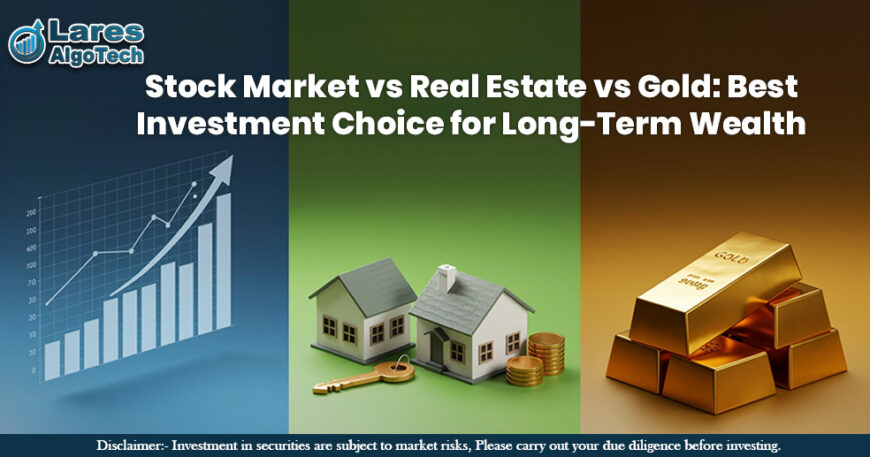
Stock Market vs Real Estate vs Gold: Best Investment Choice for Long-Term Wealth (India – 2026 Perspective)
Introduction: Why the Investment Debate Matters in 2026
India is standing at a crucial financial crossroads in 2026. Rising inflation, global geopolitical uncertainty, changing interest-rate cycles, and rapid technological disruption have forced Indian investors to rethink how and where they allocate their money. The age-old debate—Stock Market vs Real Estate vs Gold—has never been more relevant than it is today.
For decades, Indian households relied heavily on physical assets like property and gold. Real estate symbolized stability and social status, while gold represented safety, tradition, and crisis protection. However, over the last two decades, the stock market has emerged as a powerful wealth-creation engine, fueled by India’s economic growth, corporate expansion, and increasing retail participation.
In 2026, investors are no longer asking whether to invest, but where to invest for long-term wealth creation. The question is no longer emotional—it is strategic.
This comparison matters because every asset class behaves differently across:
- Economic cycles
- Inflation phases
- Liquidity needs
- Tax structures
- Risk tolerance levels
Many investors make the mistake of emotionally committing to one asset class without understanding its long-term implications. Smart investors, however, focus on asset allocation, not asset obsession.
In this detailed guide by Lares Algotech, we break down Stock Market vs Real Estate vs Gold using a practical Indian lens—covering returns, risks, taxation, liquidity, inflation protection, and wealth-building potential—so you can make informed, data-driven decisions rather than emotional ones.
2 Understanding the Three Core Asset Classes
2.1 Stock Market: Ownership in Growing Businesses
Stock market investing is fundamentally about owning a share of productive businesses. When you buy equity shares, mutual funds, ETFs, or index funds, you participate directly in corporate growth and India’s economic expansion.
Key forms of stock market investing include:
- Direct equity shares
- Equity mutual funds
- Index funds
- Exchange-Traded Funds (ETFs)
The biggest strength of stock market investing lies in compounding. When profits are reinvested year after year, wealth grows exponentially rather than linearly. Over long periods (20–30 years), equities have historically outperformed most other asset classes.
Returns from stocks come through:
- Capital appreciation (price increase)
- Dividends (profit sharing)
In a growing economy like India, equities benefit from productivity gains, technological adoption, demographic dividends, and increasing consumption.
2.2 Real Estate: Tangible Asset & Rental Income
Real estate refers to residential and commercial properties purchased for appreciation, rental income, or both. In India, real estate is deeply emotional—often considered the ultimate symbol of financial success.
There are two major return components:
- Capital appreciation
- Rental income
Residential real estate usually offers lower rental yields (2–3%) but emotional comfort. Commercial real estate offers higher yields but requires larger capital and expertise.
Urbanization, infrastructure development, and migration trends play a major role in real estate returns. However, liquidity constraints, legal complexities, and high entry costs significantly impact real returns.
2.3 Gold: Traditional Store of Value
Gold has been part of Indian financial culture for centuries. It is viewed as:
- A hedge against uncertainty
- A store of value
- A crisis asset
Modern investors can access gold via:
- Physical gold
- Digital gold
- Gold ETFs
- Sovereign gold bonds
Gold does not generate income. Its primary function is capital preservation, especially during inflation spikes, currency devaluation, or geopolitical crises.
3️ Historical Performance Comparison in India (1970–2025)
Over long periods, data reveals a clear hierarchy in returns.
Approximate long-term CAGR (India):
- Equities: 12–15%
- Real Estate: 8–10% (city-dependent)
- Gold: 7–8%
During:
- Recessions: Gold performs best
- Bull markets: Equities dominate
- High inflation: Equities + gold outperform real estate
Stock markets recover faster after crises, while real estate cycles are slow and gold often stagnates after spikes.
4️ Risk Analysis: Which Investment Is Safer?
Stock Market Risks
- Short-term volatility
- Market crashes
- Sector-specific risks
However, long-term risk reduces significantly with time, diversification, and discipline.
Real Estate Risks
- Illiquidity
- Legal disputes
- Regulatory changes
- Capital lock-in
Gold Risks
- No cash flow
- Long periods of stagnation
- Storage and purity issues
No asset is risk-free. Risk depends on time horizon and behavior, not asset class alone.
5️ Returns & Wealth Creation Potential
Stock Market
Equities excel at wealth creation, especially through SIPs and long holding periods. Compounding works best when time is your ally.
Real Estate
Returns are often overestimated due to ignored costs:
- Maintenance
- Taxes
- Vacancy
- Transaction expenses
Gold
Gold protects purchasing power but rarely creates exponential wealth.
6️ Liquidity Comparison
- Stocks: Highly liquid (sell in minutes)
- Real Estate: Months or years to exit
- Gold: ETFs liquid, physical gold slower
Liquidity matters during emergencies—and equities clearly win here.
7️ Taxation: How Much Do You Actually Keep?
Stock Market
- LTCG tax efficiency
- Favorable mutual fund structures
- Lower friction costs
Real Estate
- High stamp duty
- Capital gains complexities
- Rental income taxed at slab rates
Gold
- Capital gains tax
- GST on physical gold
- ETFs more efficient than jewelry
8️ Inflation Protection
- Stocks: Best inflation hedge long-term
- Real Estate: Partial hedge
- Gold: Short-term hedge during spikes
9️ Investment Costs & Entry Barriers
- Stocks: Start with ₹500 SIP
- Real estate: High ticket size + leverage
- Gold: Making charges & storage costs
10 Emotional vs Rational Investing
Indian investors emotionally favor gold and property, while fearing stock volatility. Data proves rational, disciplined equity investing delivers superior outcomes.
1️1️ Who Should Invest in What?
- Young investors: Stocks dominate
- Salaried professionals: SIPs + small gold
- Business owners: Balanced mix
- Retirees: Stability-focused allocation
1️2️ Portfolio Allocation Strategy
Smart investors don’t choose one—they balance all three:
- Aggressive
- Balanced
- Conservative
Regular rebalancing is key.
1️3️ 2026 Outlook
- Stocks: Strong growth drivers
- Real estate: Selective opportunity
- Gold: Insurance, not growth
1️4️ Common Myths Debunked
- Real estate can fall
- Gold isn’t risk-free
- Stock market isn’t gambling
1️5️ Final Verdict: Stock Market vs Real Estate vs Gold
| Goal | Best Asset |
| Growth | Stock Market |
| Stability | Gold |
| Income | Real Estate |
| Liquidity | Stock Market |
| Tax Efficiency | Stock Market |
Final Thought
For long-term wealth creation, stock market investing leads when done right—with discipline, patience, and informed decision-making. Real estate and gold play supporting roles, but equities drive real financial independence.
About Lares Algotech
Lares Algotech empowers Indian investors with technology-driven tools, data-backed insights, and disciplined frameworks to navigate modern markets confidently and build sustainable long-term wealth.
If you want, I can now:
- Add 15 FAQs (120 words each)
- Create SEO meta title & description
- Rewrite this into a premium PDF / investor guide
- Adapt it for Bull8 / retail investors / beginners
- Turn it into a multi-part blog series
FAQs
Is the stock market better than real estate for long-term wealth creation in India?
For long-term wealth creation, the stock market has historically outperformed real estate in India when measured over 20–30 years. Equities benefit from compounding, economic growth, corporate profitability, and reinvestment of earnings. Real estate, while emotionally reassuring, often delivers lower net returns after accounting for maintenance costs, taxes, stamp duty, and illiquidity. The stock market also allows diversification across sectors and geographies with smaller capital. However, real estate may still play a role for income generation or personal use. For investors focused purely on long-term wealth creation and flexibility, disciplined stock market investing generally offers superior outcomes compared to real estate.
Why do Indian investors still prefer gold despite lower long-term returns?
Indian investors prefer gold largely due to cultural beliefs, emotional security, and historical experiences of economic uncertainty. Gold is seen as a safe-haven asset that protects wealth during crises such as inflation spikes, currency depreciation, or geopolitical instability. Unlike stocks, gold’s price volatility feels less stressful because it is not tracked daily by most households. Additionally, gold holds social and traditional value, especially during weddings and festivals. However, from a financial perspective, gold does not generate income and often delivers modest long-term returns. In modern portfolios, gold works best as a stability and risk-hedging tool rather than a primary wealth-creation asset.
3️ How does inflation impact stock market, real estate, and gold investments?
Inflation reduces the purchasing power of money over time, making investment returns critical. The stock market generally outperforms inflation in the long run because companies raise prices, expand profits, and grow earnings. Real estate partially protects against inflation, as property prices and rents tend to rise over time, though returns vary by location. Gold performs well during short-term inflation spikes but may underperform during long periods of stable growth. Among the three, equities have consistently shown the strongest ability to beat inflation over decades, making them the most effective long-term hedge against rising living costs in India.
Is real estate still a good investment option in India in 2026?
Real estate in India can still be a good investment in 2026, but only when chosen carefully. Location, project quality, legal clarity, and demand dynamics play a crucial role in returns. Unlike earlier decades, real estate appreciation is no longer guaranteed across all cities. Oversupply, regulatory changes, and high transaction costs have reduced returns in many areas. Real estate works best for investors seeking rental income, asset diversification, or end-use housing. However, for pure financial growth, investors must be selective and realistic. Compared to the stock market, real estate requires higher capital, patience, and risk management to generate meaningful returns.
Which investment is safest: stock market, real estate, or gold?
Safety depends on time horizon, liquidity needs, and investor behavior rather than the asset itself. Gold feels safest during uncertainty because it preserves value in crises, but it does not generate income. Real estate appears safe due to its physical nature, yet legal disputes and illiquidity can pose significant risks. The stock market is volatile in the short term but becomes relatively safer over long periods due to economic growth and diversification. For long-term investors with discipline, equities often carry lower real risk than perceived. True safety comes from diversification across all three assets, not overexposure to one.
How liquid are stock market, real estate, and gold investments?
Liquidity refers to how quickly an investment can be converted into cash. The stock market is the most liquid, allowing investors to sell shares or mutual funds within minutes during market hours. Gold ETFs and digital gold also offer reasonable liquidity, while physical gold may take longer to sell at fair prices. Real estate is the least liquid asset, often taking months or even years to exit, especially during slow market conditions. Liquidity becomes critical during emergencies, job loss, or sudden financial needs. From this perspective, stocks clearly outperform real estate and physical gold, making them more flexible for modern investors.
What are the tax implications of investing in stocks, real estate, and gold?
Taxation significantly impacts net returns. Stock market investments are relatively tax-efficient, especially equity mutual funds and long-term holdings. Long-term capital gains on equities are taxed at lower rates compared to other assets. Real estate attracts high transaction costs, stamp duty, and capital gains tax, although indexation provides some relief. Rental income is taxed as per income slabs. Gold investments are taxed on capital gains, and physical gold also includes GST and making charges. Among the three, equities offer the most favorable tax structure for long-term investors, especially when invested through systematic and diversified vehicles.
Can gold replace fixed deposits as a safe investment?
Gold should not be seen as a replacement for fixed deposits. Fixed deposits provide predictable returns, capital safety, and regular income, while gold’s price fluctuates and does not generate cash flow. Gold works better as a hedge against inflation and economic uncertainty rather than a steady income source. In some years, gold may outperform fixed deposits, but it can also remain stagnant for long periods. For conservative investors, a combination of fixed deposits and a small allocation to gold offers better balance. Gold complements fixed income instruments but cannot fully replace their role in financial planning.
Why is the stock market considered risky despite strong long-term returns?
The stock market is considered risky mainly because of short-term volatility and emotional reactions to price movements. Market corrections, crashes, and daily fluctuations can cause fear, especially for new investors. However, historically, markets recover over time and reward patient investors. Risk increases when investors chase tips, time the market, or panic-sell during downturns. When approached with discipline, diversification, and long-term focus, equity risk reduces significantly. The perception of high risk often comes from poor behavior rather than the asset itself. Education and a structured investment approach transform stock market risk into opportunity.
How much should a beginner invest in stocks, real estate, and gold?
Beginners should focus on affordability, liquidity, and learning curve. Stocks allow starting with small SIPs, making them ideal for new investors. Real estate usually requires a large capital commitment and is not suitable for beginners focused on flexibility. Gold can be added gradually through ETFs or sovereign gold bonds. A common beginner allocation could be higher exposure to equities, a small portion to gold, and minimal or no real estate initially. As income and experience grow, allocations can evolve. The key is to start early, stay consistent, and avoid locking large capital prematurely.
Is real estate income more stable than stock market returns?
Real estate income, primarily rental income, appears stable but is not guaranteed. Vacancies, tenant defaults, maintenance issues, and regulatory changes can disrupt cash flows. Rental yields in India are often lower than expected, especially after accounting for costs. Stock market returns fluctuate daily but offer flexibility and transparency. Dividend income from equities can also provide stability when diversified properly. Over long periods, stock market income and appreciation tend to be more scalable and efficient. Stability depends on diversification and management, not merely the asset class. Both require planning, but equities offer better adaptability.
Should retirees avoid the stock market completely?
Retirees should not completely avoid the stock market, but they should reduce exposure to volatility. A conservative allocation to equities helps protect purchasing power against inflation, even during retirement. Avoiding stocks entirely may increase the risk of money losing value over time. Retirees can focus on stable, diversified equity funds rather than aggressive growth stocks. Gold can provide stability, while fixed income ensures regular cash flow. The goal is balance, not elimination. Proper asset allocation helps retirees maintain financial independence while managing risk effectively.
How does compounding make stocks superior for long-term investors?
Compounding allows returns to generate further returns over time, creating exponential growth. In the stock market, reinvested profits, dividends, and SIP contributions amplify compounding effects. Over 20–30 years, even moderate annual returns can multiply wealth significantly. Real estate compounding is slower due to illiquidity and limited reinvestment options. Gold does not compound in the traditional sense, as it does not generate income. Compounding works best with time, consistency, and reinvestment—conditions most easily met through equity investing. This is why stocks dominate long-term wealth creation when held patiently.
Is it risky to invest only in one asset class?
Yes, concentrating investments in a single asset class increases risk significantly. Each asset behaves differently across economic cycles. Stocks may underperform during crashes, real estate during downturns, and gold during growth phases. Diversification spreads risk and improves stability. A well-balanced portfolio includes exposure to equities for growth, gold for protection, and real estate for income or diversification. Over-reliance on one asset exposes investors to avoidable volatility and missed opportunities. Asset allocation, not asset selection alone, determines long-term success. Smart investors balance emotions with data-driven diversification.
What is the smartest investment strategy for Indian investors in 2026?
The smartest strategy in 2026 is not choosing between stock market vs real estate vs gold, but combining them intelligently. Equities should form the core for long-term growth, supported by gold for stability and selective real estate exposure where suitable. Regular investing, periodic rebalancing, and disciplined behavior matter more than timing the market. Investors should align asset allocation with age, income stability, and goals. Education, patience, and data-driven decisions are essential. When implemented correctly, a balanced strategy delivers sustainable wealth creation while managing risk across market cycles.