
Introduction
A stock closed at ₹100 yesterday. Today, it climbs to ₹105 and seems to get stuck there. You place a buy order at ₹105, but it stays pending even though your trading app shows that exact price. The stock may have reached its upper circuit, and your order is waiting for a seller.
The opposite can happen when a stock falls to its lower circuit. You may see a price of ₹95 on the screen and still struggle to sell because there are too few buyers at that price.
To understand the upper circuit and lower circuit in the share market, it helps to follow two things separately. The exchange sets the range in which a stock can trade, and the order book determines whether there is someone available to trade with you. A price on your screen tells you where the stock last traded. The orders currently in the market tell you whether you can buy or sell there now.
What Is an Upper Circuit in the Share Market?
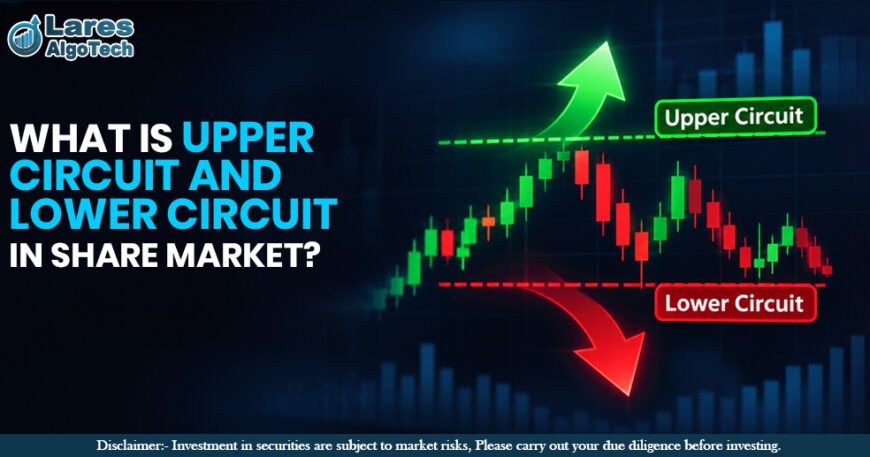
An upper circuit is the highest price at which a stock with a fixed daily price band can trade during that session. If a stock closed at ₹100 and has a 5% price band, its upper circuit is ₹105. Buyers can bid ₹105, and trades can take place at that price whenever their orders match with sell orders.
Imagine the company announces better-than-expected quarterly results before the market opens. Buyers begin placing orders, and sellers at ₹101, ₹102 and ₹103 find buyers quickly. As demand builds, the stock reaches ₹105. At that point, buyers can join the queue at ₹105. The upper limit caps the price they can offer during that session.
A stock can touch its upper circuit and trade below it later in the day as the balance between buyers and sellers changes. When traders say a stock is locked at its upper circuit, they usually mean buy orders have piled up at the limit while few or no sellers are available. One look at the last traded price tells you the stock reached ₹105. A look at the order book shows whether buyers are still queuing there.
What Is a Lower Circuit in the Share Market?
A lower circuit is the lowest price at which a stock with a fixed daily price band can trade during that session. For the same stock that closed at ₹100 with a 5% band, the lower circuit is ₹95.
Suppose the company announces that a major customer has cancelled a contract. Several shareholders decide to sell, and buyers at prices above ₹95 take only part of the available quantity. The stock eventually trades at ₹95. Sellers who still want to exit can offer their shares at the lower limit. Their orders move forward as matching buy orders arrive.
This is where the difference between seeing a price and being able to sell becomes practical. Your holdings may be valued using the latest traded price of ₹95, but you could have a sell order at that same price waiting for a buyer. If only a small quantity is available to buy, your order may be partly filled or stay pending behind other sellers.
A stock can also recover from its lower circuit during the same session. If enough buyers enter and the sell queue clears, subsequent trades can take place above ₹95.
How Are Upper and Lower Circuit Limits Calculated?
For a stock with a standard fixed daily band, start with the previous trading session’s closing price. Work out the band percentage in rupees, then add that amount for the upper limit and subtract it for the lower limit.
- Upper circuit price = Previous closing price × (1 + price band percentage)
- Lower circuit price = Previous closing price × (1 − price band percentage)
For a stock that closed at ₹100, a 5% band works out to ₹5 on either side. The upper circuit is ₹105 and the lower circuit is ₹95. Here is how the numbers change across four fixed price bands used by NSE.
| Daily price band | Previous closing price | Upper circuit | Lower circuit |
| 2% | ₹100 | ₹102 | ₹98 |
| 5% | ₹100 | ₹105 | ₹95 |
| 10% | ₹100 | ₹110 | ₹90 |
| 20% | ₹100 | ₹120 | ₹80 |
The band is measured from the previous close, even if the stock opens at a different price. In the 5% example, a stock opening at ₹103 still has an upper limit of ₹105. That leaves ₹2 between its opening price and the upper circuit.
The reference price can change the next trading day. If the stock closes at ₹95 and the same 5% band applies the following day, the next lower limit in this example is ₹90.25. Two consecutive 5% drops take the stock from ₹100 to ₹90.25, a cumulative decline of 9.75%. For an actual order, use the published limits for that security on the exchange where you plan to trade.
Can You Buy or Sell When a Stock Hits Circuit?
Yes, a trade can go through at the circuit price if a matching order is available. Which side of the trade you are on matters because a stock at its limit can have many orders on one side and very few on the other.
Buying and selling at the upper circuit
Imagine there are buy orders for 500 shares at ₹105 and no sell orders waiting. You place a buy order for another 50 shares at ₹105. Your order joins the queue at that price. If a seller offers 100 shares at ₹105, those shares can go to buyers ahead of you while your order stays pending.
If you already own shares and want to sell, those waiting buyers can make a sale possible. The order book can change between the time you look at it and the time your order reaches the exchange, so the quantity you saw on screen may have changed by then.
Buying and selling at the lower circuit
Suppose several investors are selling at ₹95, and you place an order to sell 100 shares. When your order reaches the front of the queue, a buyer enters an order for 30 shares. Your sell order can fill for 30 shares, with the remaining 70 waiting for another buyer.
A buyer entering the same market may find plenty of shares offered at ₹95. The difficulty at the lower circuit often falls on sellers because they are the ones competing for limited demand.
How the exchange decides whose order goes first
In the normal equity market, NSE matches orders using price-time priority. A higher buy bid or a lower sell offer gets price priority. If two orders are at the same price and on the same side, the one that arrived first generally gets priority.
When many orders collect at the same circuit price, time priority explains why someone else can receive a fill while you still see Pending. It also explains why a stock can record fresh trades at the circuit even while many orders remain open.
Why Do Stocks Hit Upper or Lower Circuit?
A large change in expectations can bring a rush of orders into the market. Strong earnings, a major contract win or a favourable regulatory decision can attract buyers. Weak results, a lost customer or problems with debt repayments can bring more sellers to the market.
Sometimes, the explanation is simply that the stock has low liquidity. Imagine two companies announce similar news. One stock has thousands of shares available at prices close to its last trade. The other has only a few hundred. A burst of buying can use up the available sell orders in the second stock much faster and push it to the upper circuit.
Price bands limit how far a stock can move in one session. The reason behind the move takes more digging. If the price jumps shortly after an exchange filing, the timing gives you a starting point. If trading volume is thin, a relatively small number of orders may have had a large effect. The circuit tells you where the price reached its limit. Company announcements and trading activity give you more context about how it got there.
How Do Stock Price Bands and Market-Wide Circuit Breakers Work?
A stock price band applies to an individual security. When that stock reaches its upper or lower circuit, matching orders can still result in trades within the permitted range. Other stocks can continue to trade under their own exchange rules.
A market-wide circuit breaker is triggered by a sharp move in a benchmark index. In India, the system uses thresholds of 10%, 15% and 20% in either direction, based on whichever of the Nifty 50 or BSE Sensex reaches the relevant level first. Depending on the threshold and the time of day, this can trigger a coordinated halt across equity and equity derivatives markets. A 20% move triggers a halt for the remainder of the trading day.
The scope matters when you are trying to understand what you see on your trading app. A single stock stuck at ₹95 points you towards its price band and order book. A market-wide halt affects trading across a much broader set of securities.
Do All Stocks Have the Same Circuit Limits?
The applicable price band varies by security. A stock with a 2% fixed band has a narrower daily trading range than one with a 10% band. Exchanges can also revise price bands, including through their surveillance processes. A limit you saw in a screenshot last week may have changed by the time you place an order.
On NSE, stocks for which derivatives are available use a dynamic price band. The exchange sets an initial operating range and can widen it when specified criteria are met. That means the range you see earlier in the session can change during the day. Check the current limits on the exchange or in your trading app, particularly when you are tracking a fast-moving stock.
What to Check When a Stock Reaches Circuit
- Current circuit prices. Confirm the upper and lower limits for the stock on the exchange where your order is placed.
- Market depth. Check the available buy and sell quantities. A large sell queue at the lower circuit gives you more information about your chances of an immediate fill than the last traded price alone.
- Order status. Check whether your order is pending, partly filled, executed, or rejected. If it is partly filled, look at the remaining quantity.
- Company announcements. Look for an exchange filing or other company update that may explain the sudden price move.
FAQ
Can a stock hit its upper or lower circuit on consecutive days?
Yes. If heavy buying or selling continues, a stock can reach its circuit on consecutive trading days. In a typical fixed-band example, the next session’s limits are calculated using the latest closing price and the applicable band.
Can a stock move away from the circuit price on the same day?
Yes. A stock at the upper circuit can trade lower as buying pressure eases or more sellers arrive. A stock at the lower circuit can trade higher when incoming buyers absorb enough of the shares offered at the lower limit.
What happens to a pending day order at market close?
A standard day order expires at the end of the trading session. If it was partially executed, the completed trades stand and the unfilled quantity expires. Check the order status in your trading app before trying to place it again.
Will my stop-loss sell order execute at the lower circuit?
Execution depends on whether a buyer is available once the order triggers. For example, a sell stop-limit order may trigger at ₹97 with a limit of ₹96. If the only available buy bids are at ₹95, the sell order can remain unfilled because its limit requires a price of ₹96 or better.
Conclusion
When a ₹100 stock has a 5% fixed daily band, ₹105 and ₹95 tell you how far it can trade in that session. At either limit, your ability to buy or sell still depends on the quantity available on the other side and where your order sits in the queue. If your screen shows ₹95 and your sell order is pending, check the buy quantity and your order status. Those two details explain more about your next possible fill than the circuit price alone.