
Introduction
Every trading decision should begin with a clear objective. Some traders want to participate in a possible price rise. Others expect prices to fall or want to protect investments they already hold. Call and put options can serve these different purposes, but understanding their structure is essential before using them.
Options involve more than predicting market direction. The strike price, premium, expiry, volatility, and position size all influence the result. A trader can correctly anticipate a price movement and still lose money if the move happens too slowly or fails to cover the premium paid.
This guide explains how call and put options work, how they relate to trading goals, and which risks deserve attention.
What Are Call and Put Options?
Options are derivative contracts whose value is linked to an underlying asset, such as a stock or index. The two basic types are calls and puts.
What Is a Call Option?
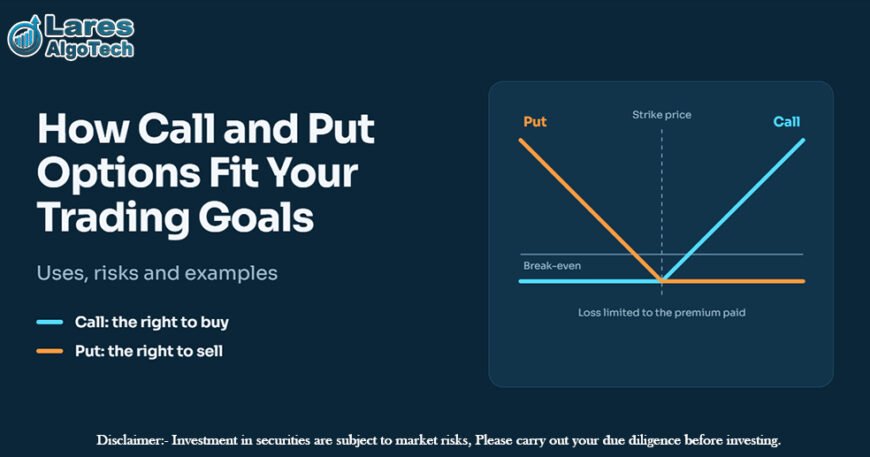
A call option gives its buyer the right, but not the obligation, to buy the underlying asset at a specified strike price, subject to the contract’s exercise and settlement terms.
Traders commonly buy calls when they expect the underlying price to rise. However, the size and timing of that rise matter because purchasing the option involves paying a premium.
What Is a Put Option?
A put option gives its buyer the right, but not the obligation, to sell the underlying asset at a specified strike price, subject to the contract’s terms.
Traders may buy puts when they expect prices to decline. Investors can also use appropriately selected puts to help protect existing holdings.
The buyer pays a premium, while the seller receives it and accepts the corresponding contractual obligation. Consequently, buying and selling options create different risks.
Essential Terms for Options Trading for Beginners
Before comparing positions, understand these terms:
- Underlying: The stock, index, or other asset linked to the option.
- Strike price: The price specified in the option contract.
- Premium: The market price paid to purchase the option.
- Expiry: The date on which the contract expires.
- Lot size: The number of underlying units represented by a contract.
- Intrinsic value: The amount by which an option is in the money.
- Time value: The part of the premium above intrinsic value.
- Breakeven: The level at which a position covers its cost under stated assumptions.
An option can be in the money and still produce a loss for its buyer. Intrinsic value alone does not account for the premium paid or trading costs.
Call vs Put Options: Understanding the Difference
The following comparison applies specifically to buying options:
| Comparison | Buying a call | Buying a put |
| Typical directional outlook | Bullish | Bearish |
| Buyer’s contractual right | Buy at the strike price | Sell at the strike price |
| Common purpose | Participate in a possible rise | Participate in a possible fall or hedge holdings |
| Purchase cost | Call premium | Put premium |
| Expiry breakeven before costs | Strike price + premium | Strike price − premium |
These breakeven formulas apply to standalone purchased options held to expiry, before charges.
Before expiry, an option’s market price also reflects remaining time and implied volatility. A trader who exits early therefore needs to compare the sale premium with the purchase premium, while accounting for costs.
Selling calls or puts produces different exposures from those shown in this table.
Start with the trading goal.
Choosing an option should follow the trading objective.
Taking a Directional Position
A trader expecting a rise may consider a purchased call. A trader expecting a decline may consider a purchased put. In both cases, the expected movement must be assessed alongside the premium and available time.
Protecting Existing Holdings
An investor concerned about a temporary decline may consider a protective put. Its purpose is to offset part of the loss on an existing holding during the protection period.
Defining Exposure
Purchased options can provide a defined initial premium commitment. However, a smaller upfront payment does not automatically make a position affordable or suitable.
Traders should assess the total amount at risk across all contracts and understand any obligations that can arise through exercise or settlement.
How a Call Option Works: A Practical Example
Assume a hypothetical underlying asset trades at ₹1,000. A trader buys a call with:
- Strike price: ₹1,000
- Premium: ₹40 per unit
- Expiry breakeven before costs: ₹1,040
At expiry, the call’s payoff is the amount by which the underlying price exceeds the strike, or zero if it does not.
| Underlying price at expiry | Call payoff per unit | Net result after premium, before costs |
| ₹1,100 | ₹100 | ₹60 profit |
| ₹1,040 | ₹40 | Breakeven |
| ₹1,020 | ₹20 | ₹20 loss |
| ₹980 | ₹0 | ₹40 loss |
The ₹1,020 outcome illustrates an important point: the underlying price rose, but the trader still lost money. The ₹20 payoff did not recover the ₹40 premium.
At ₹980, the call expires without intrinsic value, and the premium is lost.
These figures are per unit. To calculate the contract result, multiply by the applicable lot size and deduct transaction costs.
This is a simplified expiry illustration. Before expiry, the option can trade above its intrinsic value because it may still have time value. Its resale price can also change with implied volatility.
How a Put Option Works: A Practical Example
Now assume the same hypothetical underlying trades at ₹1,000, but the trader expects a decline.
The trader purchases a put with:
- Strike price: ₹1,000
- Premium: ₹30 per unit
- Expiry breakeven before costs: ₹970
At expiry, the put’s payoff is the amount by which the strike exceeds the underlying price, or zero if it does not.
| Underlying price at expiry | Put payoff per unit | Net result after premium, before costs |
| ₹900 | ₹100 | ₹70 profit |
| ₹970 | ₹30 | Breakeven |
| ₹980 | ₹20 | ₹10 loss |
| ₹1,020 | ₹0 | ₹30 loss |
A fall to ₹980 is insufficient to recover the premium. The trader needs a larger decline to reach breakeven at expiry, before costs.
Using the Put as Protection
Suppose an investor owns the underlying at ₹1,000 and buys the matching ₹1,000-strike put for ₹30.
If the underlying falls to ₹900 at expiry, the holding loses ₹100 per unit, while the put provides a ₹100 payoff. The combined loss is approximately the ₹30 premium, before costs.
This assumes matching exposure and compatible contract terms. Using an index put to hedge a different portfolio can leave a mismatch because the portfolio may move differently from the index.
Options Trading Strategies for Different Objectives
Different combinations change the relationship between cost, potential gains and possible losses.
Long Call
A long call is a purchased call. It provides bullish exposure, but the buyer can lose the full premium if the position does not develop favourably.
Long Put
A long put is a purchased put. It provides bearish exposure and can also form part of a hedge.
Protective Put
A protective put combines an existing holding with a purchased put. It can establish protection over a specified period, but purchasing that protection reduces the overall result by the premium and costs.
Debit Spread
A debit spread combines purchased and sold options with different strikes. For example, a bull call spread buys a lower-strike call and sells a higher-strike call with the same expiry.
Compared with buying the lower-strike call alone, the sold call reduces the upfront premium but caps potential gains. Execution and management also become more complex.
Covered Call
A covered call combines an underlying holding with a sold call against it. The premium provides a limited offset to losses, while gains above the strike are restricted. The underlying can still fall substantially.
No strategy is suitable simply because its name sounds conservative.
Main Risks of Call and Put Options
Effective options risk management requires understanding why a position can lose money.
Time Decay
Options have a finite life. As expiry approaches, remaining time value can decline.
A purchased option may therefore lose value while the underlying remains relatively unchanged. Time decay is not constant and varies with the option’s characteristics.
Changes in Implied Volatility
Implied volatility reflects the market’s pricing of expected future fluctuations.
A fall in implied volatility can reduce an option’s premium, all else equal. This can work against a buyer even when the underlying moves in the anticipated direction.
Leverage and Position Size
Options can create substantial exposure relative to the premium committed. This can produce large percentage changes in the position’s value.
Buying more contracts because each premium appears inexpensive can create an excessive total risk.
Loss of the Premium
A purchased option can expire worthless. Repeated losses can accumulate even when each individual position has a limited premium commitment.
Selling Risk
An option seller’s maximum premium receipt does not represent the maximum possible loss.
Uncovered calls have theoretically unlimited loss potential. Uncovered puts can also produce substantial losses. Margin requirements and adverse price movements can create additional funding pressure.
Liquidity and Execution
Wide bid–ask spreads can increase trading costs. Limited liquidity may make it difficult to exit at an acceptable price.
Stop-loss orders also do not guarantee a particular execution price, especially during gaps or rapid movements.
Expiry and Settlement
Traders must understand whether a contract is cash settled or physically settled and what funding, delivery, or margin obligations may arise. Contract specifications and broker procedures should be checked before holding positions near expiry.
A Practical Options Risk Management Checklist
Before entering a position, answer these questions:
What is the objective?
Identify whether the position is directional, protective, or part of a broader strategy.
What must happen, and by when?
Connect the expected move to the selected expiry.
What can be lost?
Calculate exposure across the full quantity and all strategy legs.
What are the costs?
Include premiums, spreads, brokerage and applicable charges.
How will the position be managed?
Define exit conditions, review points and responses to an adverse move.
What happens near expiry?
Check settlement requirements and broker cut-off procedures.
Paper trading can help beginners understand these mechanics. However, simulated results may not reflect live spreads, slippage, partial fills or the pressure of managing real money.
Common Mistakes to Avoid
A frequent mistake is choosing an option because its premium looks cheap. A low premium can reflect a low probability of finishing in the money, limited remaining time or other unfavourable characteristics.
Another mistake is focusing entirely on direction. An option buyer needs to consider how far and how quickly the underlying might move, as well as changes in volatility.
Traders also sometimes confuse a defined loss with a small loss. Losing the full premium on a large position can be financially significant.
Finally, adding contracts to recover an earlier loss can turn a manageable position into an excessive exposure. Position size should follow a risk budget established before entry.
FAQ’s
What is the main difference between call and put options?
A call gives its buyer the contractual right to buy the underlying at the strike price, while a put gives the right to sell it, subject to the contract’s terms. Purchased calls generally express a bullish view, while purchased puts generally express a bearish view or provide protection.
Can a call option lose value even when the underlying rises?
Yes. A small rise may be outweighed by time decay or a decline in implied volatility. At expiry, the underlying must exceed the call’s strike price plus the premium paid for the buyer to break even before costs.
How can put options protect existing investments?
An appropriately matched put can gain intrinsic value as the underlying falls below its strike, helping offset losses on the holding. Protection lasts only for the contract’s period and comes at a premium cost. A hedge may be imperfect if its exposure differs from the investment.
Is buying options always safer than selling options?
No position should be judged only by whether it is bought or sold. Purchased options generally limit the standalone option loss to the premium and costs, but the full amount can be lost. Selling risks depend on whether the position is uncovered, covered or part of a defined-risk combination.
What should beginners check before trading options?
Beginners should understand premiums, strikes, expiry, lot sizes, liquidity and settlement. They should also calculate possible outcomes, establish an affordable risk budget and know how they will exit. Understanding a payoff example is a starting point; it does not establish readiness for live trading.
Conclusion
Call and put options can support different trading goals, including directional exposure and protection of existing holdings. Their usefulness depends on how the contract fits the objective, timeframe, position size and acceptable loss.
A sound decision requires more than expecting the market to rise or fall. Traders must understand the premium, possible outcomes, execution costs and expiry obligations before entering.
Options involve significant risk and do not guarantee profits. The examples above are hypothetical and intended for education, rather than recommendations to take any particular position.