
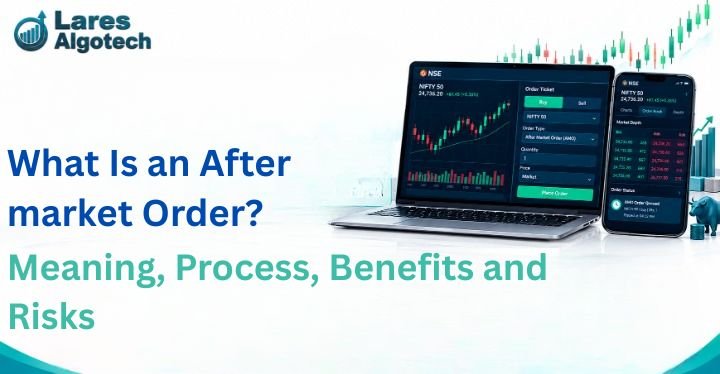
What Is an Aftermarket Order? Meaning, Process, Benefits, and Risks
The stock market follows defined trading hours, but investors don’t always have time to study securities or place orders while the market is open. A working professional may review a company after office hours, while another investor may prefer to plan an order for the next trading day without rushing at the opening. This is where an aftermarket order can be useful.
An Aftermarket Order allows a user to place an order outside regular market hours. However, the order is not executed immediately. It is stored by the stockbroker and sent to the exchange during the next eligible session. Its execution then depends on factors such as price, liquidity, available quantity, applicable price limits, and prevailing market conditions.
This guide explains the meaning of an After Market Order, how the process works, its benefits and limitations, and the checks an investor should complete before submitting one.
What Is an Aftermarket Order?
An after-market order, commonly called an AMO, is an instruction placed through a stockbroker’s trading platform outside regular exchange trading hours. The broker records the instruction and forwards it to the exchange when the next eligible session begins, subject to its systems, risk controls, and applicable exchange rules.
In simple terms, an AMO lets an investor prepare an order now for possible execution in the next market session.
Placing an AMO does not mean that a trade has been completed. It only means that the instruction has been accepted or queued by the broker for later submission. The exchange must accept the order, and a suitable counter-order must be available before a trade can occur.
An AMO may therefore be:
- Fully executed
- Partially executed
- Left pending
- Rejected
- Cancelled
Execution is never guaranteed merely because the order was placed successfully.
Why Do Investors Use Aftermarket Orders?
AMOs are mainly designed for convenience and advance planning. Many investors cannot continuously monitor the market during working hours. With an AMO facility, they can study financial information, review prices, and prepare an order after the regular session ends.
Investors may use AMOs to:
- Place an order after completing research in the evening
- Prepare for the next trading session
- Avoid placing a hurried order at the opening
- Enter a preferred limit price in advance
- Review the quantity, available funds, and order details calmly
- Manage trading activity around professional commitments
Convenience should not be confused with price certainty. Important domestic or global developments can occur while the Indian market is closed. The next opening price may therefore differ significantly from the previous closing price.
How Does an Aftermarket Order Work?
The AMO process generally follows six steps:
Select the security: Log in during the AMO window and choose the eligible security or contract.
Enter the instruction: Select buy or sell and enter the quantity, price, product, and available order type.
Submit the order: Review all details carefully. The order cannot be matched immediately because the regular session is closed.
Broker validation: The broker may check funds or margin, price limits, eligibility, quantity restrictions, and risk conditions.
Exchange submission: A valid AMO is sent to the exchange during the next eligible session and enters the applicable order book.
Status review: After the market opens, check whether the order was fully or partially executed, rejected, cancelled, or remains pending.
A limit order executes only at its specified price or a more favorable price. A market order, where permitted, seeks the best available price but does not guarantee a particular execution price.
After Market Order Example
Suppose an investor reviews Company ABC after the market closes. Its previous closing price was ₹495, and the investor is willing to buy 50 shares only at ₹500 or below. The investor places an AMO limit order for 50 shares at ₹500.
Different outcomes are possible when the order reaches the exchange:
- If sufficient shares are available at ₹500 or below, it may be fully executed.
- If only 20 shares are available within the limit, it may be partially executed.
- If the share opens at ₹515 and does not trade at ₹500 or below, it may remain unexecuted.
- If the price falls outside an applicable range, it may be rejected.
- If sufficient funds are unavailable during validation, it may not be transmitted.
This example demonstrates why an accepted AMO should not be treated as a confirmed trade.
Types of Orders That May Be Available as AMOs
Supported order types vary across brokers and market segments. Users should check the facilities currently available on their trading platform.
A limit order specifies the maximum buying price or minimum selling price, providing price control without guaranteeing execution.
A market order, where permitted, seeks the best available price after reaching the exchange. However, its execution price can differ from the previous closing price.
Some platforms may also support specific stop-loss orders, which become active only after the selected trigger condition is met. Users should verify supported order types and trigger-price rules before placing an AMO.
After Market Order vs. Regular Market Order
| Basis | After Market Order | Regular Market Order |
| Placement time | Outside regular market hours | During an active trading session |
| Exchange submission | During the next eligible session | Normally soon after placement |
| Price information | Mainly closing or historical information | Live market prices |
| Immediate execution | Not possible while the session is closed | Possible if a match is available |
| Overnight gap exposure | Present | Usually absent for an order completed in the same session |
| Execution guarantee | No | No |
| Modification | Subject to AMO cut-off and order status | Usually possible while pending |
Both AMOs and regular orders remain subject to exchange acceptance, liquidity, price conditions, and broker risk controls.
Is an AMO the Same as a Pre-Open Order?
No. An after-market order is a broker facility for accepting an instruction outside regular trading hours. The pre-open session is an exchange-operated mechanism intended to support price discovery before normal trading begins.
Depending on the broker’s process, security, and applicable exchange framework, an AMO may be transmitted during an eligible pre-open phase or when the regular session starts.
Investors should not assume that every AMO participates in the pre-open session. They should verify the applicable process with their stockbroker.
When Can an Aftermarket Order Be Placed?
There is no single AMO timing that applies to every broker, exchange, and market segment. The facility may open after the regular session ends and close before the next session begins. Maintenance and risk-processing periods can also affect availability.
Timings may differ across:
- Equity shares
- Equity futures and options
- Currency derivatives
- Commodity derivatives
- Special trading sessions
Trading holidays and special sessions can also change the regular schedule. Users should confirm the current AMO window, eligible products, and transmission policy directly on their broker’s platform.
Official notices and investor information can be checked through the NSE investor portal and the SEBI investor website.
Benefits of Aftermarket Orders
Convenient Market Access
AMOs allow people who are occupied during market hours to prepare orders later without continuously monitoring a screen.
More Time to Review Information
An investor can examine company disclosures, price data, available capital, and personal risk limits before submitting an instruction. More time can encourage a structured decision-making process, although it cannot remove investment risk.
Advance Order Planning
Users can define the security, quantity, and acceptable price beforehand instead of making a hurried decision when the market opens.
Price Control Through Limit Orders
Where a limit AMO is supported, an investor can set a maximum buying price or minimum selling price. This provides price discipline, but the order may remain unexecuted if the market does not reach the selected price.
Risks and Limitations of Aftermarket Orders
Overnight Price Gap
Company announcements, economic data, geopolitical developments, or global-market movements can cause a security to open above or below its previous closing price. The price visible while placing an AMO may therefore differ from the next available price.
Non-Execution or Partial Execution
An AMO may remain unexecuted if its limit price is not reached or a matching order is unavailable. If only part of the requested quantity is available, the remaining quantity may stay pending or expire.
Slippage
A permitted market order may execute at a price different from the user’s expectation. The difference can be greater when market volatility is high or liquidity is limited.
Order Rejection
Insufficient funds, invalid prices, unsupported order types, restricted securities, or broker risk-management controls can cause an order to be rejected.
Corporate Actions and Market News
Dividends, bonus issues, stock splits, mergers, financial results, and other announcements can affect reference prices and trading conditions. Investors should review recent disclosures instead of relying only on the previous closing price.
Common Reasons an AMO May Be Rejected
An aftermarket order may be rejected because of:
- Insufficient available funds or margin
- Price outside the permitted range
- Incorrect or unavailable product type
- Security or contract not eligible for AMO
- Invalid order quantity
- Expired derivative contract
- Trading suspension or surveillance restriction
- Changed margin requirements
- Broker-level risk checks
- Exchange holiday or special-session conditions
The rejection message displayed in the order book may identify the reason. If it is unclear, the user should contact the broker before placing another order.
How to Place an AMO Responsibly
Before submitting an Aftermarket Order:
- Confirm the correct security or contract symbol.
- Check whether it is a buy or sell instruction.
- Review the quantity, price, and order type.
- Understand the difference between limit and market orders.
- Check available funds, holdings, or required margin.
- Review recent company disclosures and relevant market news.
- Consider the possibility of an overnight price gap.
- Verify the applicable AMO timing and eligible segments.
- Check the order status after the market opens.
- Never treat a queued order as an executed trade.
Investors should use authorized trading applications, protect their account credentials, and review transaction alerts. They should also perform their own research and remain cautious about unsolicited tips or misleading online claims.
FAQs
What does AMO mean in the stock market?
AMO means After Market Order. It is an order placed outside regular trading hours and queued by a broker for submission during the next eligible exchange session.
Is an AMO executed immediately?
No. The order is stored while the relevant market is closed and transmitted later according to the broker’s process and the applicable exchange schedule.
Does placing an AMO guarantee execution?
No. Execution depends on price, liquidity, exchange acceptance, available funds or margin, order eligibility, and risk controls.
Can I modify or cancel an AMO?
Modification or cancellation may be possible before the applicable cut-off time or while the order remains open. Availability depends on the platform, transmission stage, and order status.
Can an AMO be partially executed?
Yes. If only part of the quantity is available at an acceptable price, that portion may execute while the remaining quantity stays pending or expires.
Conclusion
An after-market order gives investors the flexibility to submit trading instructions outside regular market hours. It can support advance planning and help users who cannot access the market during the day. However, the order is only queued for the next eligible session; it is not executed at the time of placement. Overnight price gaps, liquidity, price conditions, available funds, exchange rules, and risk controls can all affect the outcome.
Before placing an AMO, users should verify the security, quantity, price, order type, available balance, and current trading schedule. They should also check the final status after the order reaches the exchange.
Lares Algotech India Pvt. Ltd., a SEBI-registered stockbroker, provides technology-driven access to NSE, BSE, and MCX across eligible market segments. With secure market access, advanced trading technology, low-latency order processing, and dedicated assistance, Lares Algotech supports investors and traders through a structured trading experience. Platform features, AMO timings, and order eligibility should always be verified before placing an order.
Disclaimer: This article is for educational purposes only and does not constitute investment advice or a recommendation to buy or sell any security. Securities-market investments are subject to market risks. Read all related documents carefully and consult a qualified professional where necessary.