
What Is Bid-Ask Spread & How Algo Trading Helps You Beat It
Introduction: Why Bid-Ask Spread Matters More Than You Think
When traders enter the stock market, most of them focus heavily on price direction—whether a stock will go up or down. However, very few truly understand the hidden cost of trading that quietly impacts their profitability every single day. That hidden cost is known as What Is Bid-Ask Spread.
At first glance, the difference between buying and selling prices may seem negligible. But in reality, the bid-ask spread can significantly reduce your profits—even when your trade direction is correct. Many traders are shocked to realize that they can predict the market accurately and still end up with minimal gains or even losses. The reason? Execution cost caused by the spread.
This becomes even more critical for:
- Intraday traders, who execute multiple trades daily
- Options traders, where spreads are often wider
- Scalpers, who rely on very small price movements
For such traders, even a small spread can eat into profits quickly. In fact, every trade you enter starts at a disadvantage—you begin with a loss equal to the spread.
Now, here’s the interesting part. While most traders ignore this cost, professional traders actively work to reduce its impact. And this is where algorithmic trading (algo trading) comes into play.
Algo trading is not just about automation—it is about precision, speed, and efficiency in execution. By using advanced order execution techniques, traders can significantly minimize the negative impact of the bid-ask spread.
At Lares Algotech, the focus is not just on helping traders enter the market—but helping them execute smarter trades with better pricing and reduced hidden costs.
Understanding What Is Bid-Ask Spread is the first step toward becoming a smarter trader. The next step is learning how to beat it—and that’s exactly what this guide will help you do.
What Is Bid-Ask Spread? (Basic Definition)
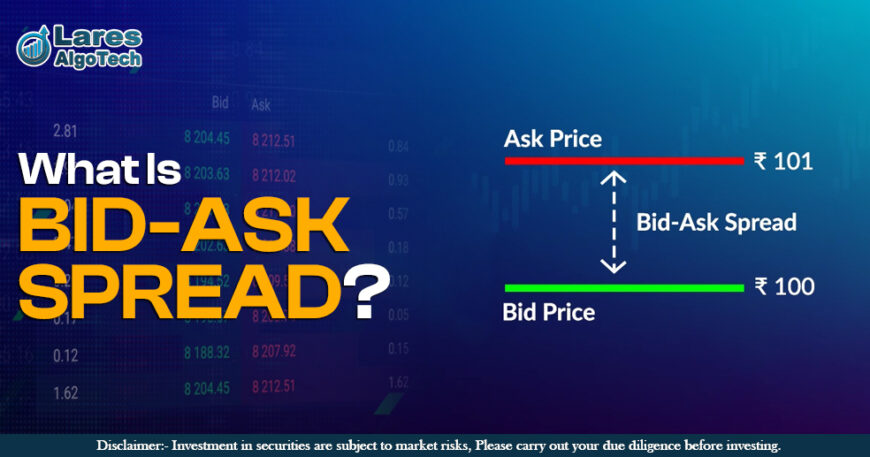
To understand trading costs, you must first clearly understand What Is Bid-Ask Spread.
In the stock market, every asset has two prices at any given moment:
- Bid Price – The highest price a buyer is willing to pay
- Ask Price – The lowest price a seller is willing to accept
The bid-ask spread is simply the difference between these two prices.
Formula:
Spread = Ask Price – Bid Price
Let’s look at a simple example:
- Bid Price: ₹100
- Ask Price: ₹100.50
Spread = ₹0.50
This means if you buy the stock at ₹100.50 and immediately sell it, you will only get ₹100—resulting in an instant loss of ₹0.50. That’s the cost of entering the trade.
This is why it is often said:
Every trade starts at a loss equal to the spread
Why Does This Spread Exist?
The spread exists because of market dynamics:
Liquidity Differences
Not every stock has equal buyers and sellers at the same price
Market Makers
These participants provide liquidity and earn from the spread
Supply and Demand
Prices fluctuate based on how many buyers and sellers are active
In highly liquid stocks, the spread is usually small. In less liquid stocks, the spread becomes wider.
Key Insight
Most beginners ignore What Is Bid-Ask Spread, assuming it’s insignificant. However, for active traders, this spread is one of the most important factors affecting profitability.
At Lares Algotech, traders are educated to focus not just on what to trade, but also on how to trade efficiently—because execution quality directly impacts returns.
How Bid and Ask Prices Work in the Stock Market
To fully understand What Is Bid-Ask Spread, you need to see how bid and ask prices actually function within the market.
At any moment, thousands of traders are placing buy and sell orders. These orders are recorded in what is called an order book.
Order Book Explained
There are two main sides:
- Buy Side (Bids) – Buyers placing orders at different prices
- Sell Side (Asks) – Sellers offering shares at different prices
The highest bid and the lowest ask together form the current market price range.
Level 1 Data
- Shows best bid and best ask price
Level 2 Data
- Shows multiple layers of bids and asks
- Provides deeper insight into market demand and supply
How Orders Get Executed
The stock market operates through a matching engine:
A trader places an order
The broker sends it to the exchange
The exchange matches it with an opposite order
Trade is executed
Execution flow:
Trader → Broker → Exchange → Matching Engine → Execution
At Lares Algotech, this entire process is optimized for speed and accuracy to ensure traders get the best possible execution.
Role of Demand and Supply
The bid-ask spread is constantly changing based on:
- Number of buyers vs sellers
- Market sentiment
- News and events
- Trading volume
If buyers are aggressive, bid prices move higher. If sellers dominate, ask prices drop.
Important Insight
The spread is not fixed—it is dynamic. It expands and contracts based on real-time market conditions.
This is why traders must not only understand What Is Bid-Ask Spread, but also learn how to navigate it intelligently.
Execution quality depends on timing, order type, and speed—areas where algorithmic trading provides a strong advantage.
Types of Bid-Ask Spread
To truly understand What Is Bid-Ask Spread, it is important to know that spreads are not the same across all instruments or market conditions. They vary depending on liquidity, volatility, and trading activity.
Tight Spread
A tight spread means the difference between the bid and ask price is very small.
Example:
Bid: ₹100 | Ask: ₹100.05
This is commonly seen in high liquidity stocks such as large-cap companies. Stocks like those listed on the National Stock Exchange of India or Bombay Stock Exchange with high trading volume often have tight spreads.
Tight spreads are ideal for:
- Intraday traders
- Scalpers
- High-frequency trading
Wide Spread
A wide spread occurs when there is a large difference between bid and ask prices.
Example:
Bid: ₹100 | Ask: ₹101
This usually happens in:
- Low liquidity stocks
- Penny stocks
- Illiquid options contracts
Wide spreads increase trading cost and risk.
Fixed vs Variable Spread
- Fixed Spread
Remains constant (common in forex markets) - Variable Spread
Changes based on market conditions (common in stock and options markets)
Spread Across Different Markets
- Stocks: Usually tight for large-cap stocks
- Options: Often wider due to lower liquidity
- Forex: Can be tight but varies during volatility
Intraday vs Overnight Spread
- Market Open: Spread is wide due to uncertainty
- Mid-session: Spread tightens (best trading time)
- Closing Hours: Spread may widen again
Key Insight
Not all spreads are equal. Understanding the type of spread helps traders decide when and where to trade efficiently.
At Lares Algotech, traders are guided to focus on liquid instruments with tighter spreads, reducing unnecessary execution cost.
Why Bid-Ask Spread Exists (Market Logic Explained)
Many traders ask a fundamental question—why does the bid-ask spread exist at all?
To understand What Is Bid-Ask Spread, you must understand that it is not a flaw in the system—it is an essential feature of how markets function.
Role of Liquidity Providers (Market Makers)
Market makers are participants who continuously provide buy and sell prices. They ensure that traders can enter and exit positions at any time.
They earn profit through the spread.
Example:
- Buy at ₹100 (Bid)
- Sell at ₹100.50 (Ask)
- Profit = ₹0.50
Risk Compensation
Market makers take on risk when they hold positions.
To compensate for:
- Price fluctuations
- Sudden volatility
- Inventory risk
They maintain a spread between buying and selling prices.
Volatility Impact
Higher volatility leads to wider spreads.
Why?
Because:
- Price uncertainty increases
- Risk for market makers increases
- They demand higher compensation
Information Asymmetry
Not all traders have the same information.
Some traders may have better insights, faster data, or institutional-level access. To protect themselves from informed traders, liquidity providers maintain a spread.
Order Imbalance
When there are more buyers than sellers (or vice versa), spreads can widen.
- High demand → Ask price rises
- High supply → Bid price falls
Key Insight
The sprezad is not random—it reflects market efficiency, risk, and liquidity conditions.
Understanding this helps traders avoid blaming the system and instead focus on optimizing execution strategy.
At Lares Algotech, traders are trained to recognize these dynamics and adapt their trading style accordingly.
Factors That Affect Bid-Ask Spread
The bid-ask spread is dynamic. It constantly changes based on multiple real-time factors. To master What Is Bid-Ask Spread, traders must understand what influences it.
Liquidit y
Liquidity is the most important factor.
- High liquidity → Tight spread
- Low liquidity → Wide spread
Stocks with high daily volume have many buyers and sellers, leading to smaller spreads.
Trading Volume
Higher trading volume reduces spread because:
- More orders are available
- Faster matching occurs
- Price discovery improves
Low volume leads to uncertainty, increasing the spread.
Market Volatility
During volatile periods:
- Prices move rapidly
- Risk increases
- Spreads widen
Example scenarios:
- Economic announcements
- Geopolitical news
- Earnings releases
Time of Day
Spread varies throughout the trading session:
- Market Open (9:15 AM):
High uncertainty → Wide spreads - Mid-session:
Stable → Tight spreads - Closing Session:
Increased activity → Volatile spreads
News and Events
Major news events can significantly impact spreads.
Examples:
- Budget announcements
- RBI policy changes
- Global market movements
These events increase uncertainty, causing spreads to widen.
Type of Stock
- Blue-chip stocks:
High liquidity → Tight spreads - Mid-cap stocks:
Moderate spreads - Penny stocks:
Very wide spreads
Options vs Equity
Options trading usually has wider spreads than equities because:
- Lower liquidity
- Complex pricing (Greeks impact)
- Varying demand across strike prices
Key Insight
The bid-ask spread is influenced by market conditions, timing, and instrument selection.
Smart traders don’t just analyze charts—they analyze execution environment.
At Lares Algotech, traders get access to tools and insights that help them choose high-liquidity instruments, reducing the impact of spread on profitability.
Bid-Ask Spread in Options Trading (Highly Important)
When it comes to understanding What Is Bid-Ask Spread, options trading deserves special attention. Compared to equity trading, the impact of spread in options is significantly higher—and often underestimated by beginners.
Why Spreads Are Wider in Options
Unlike stocks, options contracts often have:
- Lower liquidity
- Fewer buyers and sellers
- Multiple strike prices and expiries
Because of this, the difference between bid and ask prices tends to be larger.
Example of Options Spread Impact
Let’s say:
- Ask Price (Buy): ₹10
- Bid Price (Sell): ₹8
Spread = ₹2
Now imagine you buy the option at ₹10. Even if the price doesn’t move, if you sell immediately, you will only get ₹8.
Instant loss = 20%
This is why understanding What Is Bid-Ask Spread becomes critical in options trading.
Impact on Entry and Exit
- Entry Cost: You always buy at the ask (higher price)
- Exit Price: You sell at the bid (lower price)
This means your trade needs to move significantly in your favor just to break even.
Greeks + Spread Impact
Options pricing is already influenced by factors like:
- Delta (price movement sensitivity)
- Theta (time decay)
- Vega (volatility impact)
When you combine these with a wide spread, your profit potential reduces further.
Where Beginners Go Wrong
Many beginners:
- Trade illiquid options
- Ignore Open Interest (OI)
- Enter trades during low activity periods
This results in:
- Poor entry prices
- Difficult exits
- Unexpected losses
High-Risk Situations
- Weekly expiry contracts with low OI
- Far out-of-the-money options
- Sudden volatility spikes
Key Insight
In options trading, spread is not just a cost—it can be a deal breaker.
Smart traders focus on:
- High liquidity contracts
- Tight spreads
- Efficient execution
At Lares Algotech, traders are guided to select liquid options instruments and execute trades with precision to reduce spread impact.
Hidden Cost of Trading: How Spread Eats Your Profit
One of the biggest mistakes traders make is ignoring the hidden cost of trading. When learning What Is Bid-Ask Spread, it’s essential to understand how it directly affects your profits.
The Reality: Every Trade Has a Cost
Let’s break it down with a simple example:
- Buy at Ask: ₹100
- Sell at Bid: ₹99.50
Spread cost = ₹0.50
Now imagine you exit the trade at ₹100.50:
- Gross profit = ₹0.50
- Spread cost = ₹0.50
Net profit = ₹0
Even though your trade direction was correct, you earned nothing.
Entry + Exit Cost
Spread impacts both sides of the trade:
Entry Cost – You buy at a higher price
Exit Cost – You sell at a lower price
This double impact reduces profitability.
Impact on Scalping
Scalpers aim for small profits per trade.
Example:
- Target profit: ₹1
- Spread: ₹0.50
50% of profit gone instantly
Impact on Intraday Trading
Intraday traders often take multiple trades daily.
Example:
- 20 trades per day
- Average spread cost per trade: ₹0.50
Total daily cost = ₹10 per share
Over time, this becomes a massive expense.
Compounding Effect
Small costs accumulate over time:
- Daily loss → Weekly loss → Monthly loss
- Affects long-term capital growth
Spread vs Brokerage
Many traders focus only on brokerage charges.
But in reality:
Spread cost is often higher than brokerage
Ignoring this can lead to:
- Overtrading
- Reduced returns
- Frustration
Real Insight
Even professional traders carefully monitor spread before entering a trade.
At Lares Algotech, the focus is on helping traders reduce both brokerage and spread impact through better execution systems.
Manual Trading vs Spread: Where Traders Go Wrong
Understanding What Is Bid-Ask Spread is one thing—but applying that knowledge in real-time trading is another challenge. This is where manual traders often make costly mistakes.
Market Order Mistakes
Most retail traders use market orders.
This leads to:
- Buying at higher prices
- Selling at lower prices
- Increased spread cost
Market orders prioritize speed over price.
Slippage Issues
Manual execution delays can cause:
- Orders executed at worse prices
- Increased cost beyond spread
This becomes more severe during volatile markets.
Emotional Trading
Human traders often:
- Panic buy or sell
- Chase prices
- Exit trades impulsively
This results in:
- Poor entry points
- Inefficient exits
Slow Execution Speed
Markets move in milliseconds.
Manual traders:
- Analyze → Decide → Click → Execute
This delay leads to:
- Missed opportunities
- Worse price fills
Lack of Precision Timing
Manual trading lacks:
- Consistent entry strategy
- Proper order placement
- Execution discipline
Where It All Goes Wrong
When you combine:
- Market orders
- Slippage
- Emotional decisions
- Slow execution
The impact of bid-ask spread increases significantly.
Key Insight
Manual trading is not just about strategy—it is about execution quality.
Without proper execution:
- Even good strategies fail
- Profits shrink
- Losses increase
At Lares Algotech, traders are encouraged to move toward structured and rule-based trading approaches, reducing human error and minimizing spread-related losses.
What Is Slippage & How It Relates to Spread
While understanding What Is Bid-Ask Spread is essential, traders must also be aware of another hidden cost known as slippage. Both spread and slippage impact your execution, but they are not the same.
What Is Slippage?
Slippage occurs when your trade is executed at a different price than expected.
Example:
- You place a buy order at ₹100
- Your order gets executed at ₹100.30
Slippage = ₹0.30
Difference Between Spread and Slippage
- Spread:
Fixed difference between bid and ask price - Slippage:
Unexpected price difference during execution
When Does Slippage Increase?
Slippage is more likely during:
- High volatility
- News events
- Low liquidity conditions
- Fast-moving markets
Combined Impact: Spread + Slippage
Let’s understand the real cost:
- Spread cost = ₹0.50
- Slippage cost = ₹0.30
Total hidden cost = ₹0.80
This means your trade needs to move ₹0.80 in your favor just to break even.
Why Manual Traders Suffer More
Manual traders often face:
- Delay in order execution
- Use of market orders
- Emotional decision-making
This leads to higher slippage and increased losses.
Key Insight
Ignoring slippage while understanding What Is Bid-Ask Spread gives an incomplete picture of trading cost.
Real cost = Spread + Slippage
At Lares Algotech, traders benefit from systems designed to reduce both spread impact and slippage through faster and smarter execution.
How Algo Trading Helps You Beat the Bid-Ask Spread (Core Section)
Once you understand What Is Bid-Ask Spread, the next step is learning how to minimize its impact. This is where algorithmic trading (algo trading) becomes a game-changer.
Algo trading is not just automation—it is about precision, speed, and intelligent execution.
Smart Order Execution
Algo trading systems analyze:
- Market depth
- Bid and ask levels
- Order book structure
This allows them to place orders at optimal price points, reducing spread cost.
Use of Limit Orders Instead of Market Orders
Unlike manual traders who rely on market orders, algo systems primarily use limit orders.
Benefits:
- Control over entry price
- Avoid unnecessary spread cost
- Better execution efficiency
Speed Advantage (Milliseconds Execution)
Markets move extremely fast.
- Manual traders react in seconds
- Algo systems react in milliseconds
This speed ensures:
- Better price capture
- Reduced slippage
- Lower spread impact
Order Slicing
Large orders can move the market.
Algo trading breaks large orders into smaller ones using techniques like:
- Iceberg orders
- Partial execution
This helps
- Avoid price spikes
- Maintain better average execution price
Best Price Discovery
Algo systems continuously scan:
- Multiple price levels
- Liquidity zones
- Order flow
This enables execution at the most favorable price available.
Reduced Slippage
Because of speed and precision:
- Orders are executed faster
- Market impact is minimized
- Slippage is reduced
Discipline and Consistency
Algo trading removes:
- Emotional decisions
- Panic entries/exits
- Impulsive trades
This ensures consistent execution quality.
Core Message
Algo trading = Precision + Speed + Discipline
It transforms trading from guesswork into a structured and efficient process.
At Lares Algotech, advanced execution systems are designed to help traders:
- Minimize spread impact
- Reduce slippage
- Improve overall profitability
Role of Speed in Reducing Spread Impact
In modern financial markets, speed is not just an advantage—it is a necessity. To fully benefit from understanding What Is Bid-Ask Spread, traders must recognize the critical role of execution speed.
Market Moves in Milliseconds
Stock prices can change in fractions of a second.
- A delay of even 1–2 seconds
- Can result in worse entry or exit price
Delay = Higher Cost
When execution is slow:
- You may miss the best bid or ask
- You end up trading at less favorable prices
This increases effective spread cost.
Algo Trading vs Human Speed
| Factor | Manual Trading | Algo Trading |
| Reaction Time | Seconds | Milliseconds |
| Execution Speed | Slow | Instant |
| Price Accuracy | Variable | Optimized |
Server-Based Execution Advantage
Algo trading systems operate on:
- High-speed servers
- Low-latency infrastructure
- Direct exchange connectivity
This ensures:
- Faster order routing
- Minimal delay
- Better price fills
Why Speed Matters More for Active Traders
For
- Scalpers
- Intraday traders
- Options traders
Speed directly impacts:
- Profitability
- Execution quality
- Risk management
Key Insight
In trading, timing is everything.
Even the best strategy fails if execution is slow.
At Lares Algotech, traders benefit from low-latency execution systems, ensuring that orders are placed and executed with maximum efficiency.
Smart Order Types Used in Algo Trading
To truly master What Is Bid-Ask Spread, traders must go beyond basic concepts and understand how order types influence execution quality. One of the biggest advantages of algo trading is the ability to use advanced order types that help reduce spread impact.
Limit Orders (Most Important)
Limit orders allow traders to set the exact price at which they want to buy or sell.
- Buy at a specific bid price
- Sell at a specific ask price
Unlike market orders, limit orders help you avoid paying the full spread.
Example:
Instead of buying at ₹100.50 (ask), you place a limit order at ₹100.20
This reduces your effective spread cost.
Iceberg Orders
Iceberg orders split a large order into smaller visible portions.
Benefits:
- Prevents sudden price movement
- Avoids widening of spread
- Maintains better execution price
This is especially useful in low liquidity environments, where understanding What Is Bid-Ask Spread becomes even more critical.
TWAP (Time Weighted Average Price)
TWAP executes orders over a defined time period.
- Reduces market impact
- Avoids sudden spread widening
- Ensures smoother execution
VWAP (Volume Weighted Average Price)
VWAP focuses on executing trades based on volume distribution.
- Matches market liquidity
- Helps in achieving better average price
- Minimizes spread impact in active markets
Smart Order Routing
Algo systems can route orders intelligently:
- Choose best exchange price
- Access deeper liquidity
- Optimize execution
Stop-Loss Precision
Algo trading ensures stop-loss orders are:
- Placed accurately
- Triggered instantly
- Executed without delay
This prevents additional loss due to spread widening.
Key Insight
Understanding What Is Bid-Ask Spread is incomplete without knowing how to control it.
Smart order types = Better price control + Lower spread cost
At Lares Algotech, traders get access to advanced execution tools that enable efficient order placement and optimized pricing.
How Professional Traders Handle Bid-Ask Spread
Professional traders don’t just analyze charts—they actively manage execution costs. A deep understanding of What Is Bid-Ask Spread separates retail traders from professionals.
Trade High Liquidity Instruments
Professionals focus on:
- Large-cap stocks
- High-volume indices
- Liquid options contracts
Why?
High liquidity = Tight spread
Avoid Low Liquidity Stocks
Illiquid stocks have:
- Wide spreads
- Difficult execution
- High slippage
Professionals simply avoid such trades, no matter how attractive the chart looks.
Always Use Limit Orders
Instead of rushing into trades:
- They wait for the right price
- They place controlled entries
This ensures:
- Lower entry cost
- Better risk-reward ratio
Avoid Trading During Market Open
At market open:
- Volatility is high
- Spread is wide
- Price discovery is unstable
Professionals wait for the market to stabilize.
Trade During Peak Liquidity
Best time to trade:
- Mid-session hours
- When volume is high
- When spreads are tight
Monitor Order Book (Advanced Traders)
Professional traders analyze:
- Bid depth
- Ask pressure
- Market imbalance
This helps them anticipate spread changes.
Key Insight
Understanding What Is Bid-Ask Spread is not enough—managing it actively is what creates consistent profitability.
At Lares Algotech, traders are equipped with tools and insights that help them trade like professionals with better execution control.
Practical Tips to Reduce Bid-Ask Spread Impact
If you truly understand What Is Bid-Ask Spread, the next step is applying practical strategies to reduce its impact. Here are actionable tips every trader should follow.
Always Check the Spread Before Trading
Before entering any trade:
- Compare bid and ask price
- Calculate the spread
If spread is too wide, avoid the trade
Trade High Liquidity Stocks
Choose stocks with:
- High volume
- Active participation
- Tight spreads
This ensures lower execution cost.
Focus on Liquid Options Contracts
In options trading:
- Trade near-the-money strikes
- Choose high Open Interest (OI) contracts
This reduces spread significantly.
Use Limit Orders Instead of Market Orders
Market orders expose you to:
- Full spread cost
- Slippage
Limit orders give you:
- Price control
- Better execution
Avoid Panic Trading
Emotional decisions lead to:
- Poor entries
- Worse exits
- Higher spread cost
Stay disciplined and follow a structured approach.
Avoid Trading During High Volatility
During events like:
- Budget announcements
- Earnings releases
- Breaking news
Spread widens significantly
Trade at the Right Time
Best trading window:
- Mid-session (stable market)
- High liquidity period
Avoid:
- Market open
- Sudden closing volatility
Choose the Right Broker
Execution quality depends heavily on your broker.
A good broker provides:
- Fast execution
- Low latency systems
- Reliable infrastructure
Why Broker Choice Matters
Even if you understand What Is Bid-Ask Spread, poor execution can:
- Increase spread cost
- Increase slippage
- Reduce profits
At Lares Algotech, traders benefit from:
- Fast execution systems
- Low latency infrastructure
- Reliable trading platform
Helping reduce both spread and slippage impact.
Why Choosing the Right Broker Matters
Understanding What Is Bid-Ask Spread is only one part of the equation. The second—and equally important—part is how efficiently your trades are executed, which depends heavily on your broker.
Many traders assume that spreads are purely market-driven and brokers have no role. While it is true that spreads originate from the exchange, the execution quality provided by your broker determines how much of that spread actually impacts you.
Execution Speed
A fast broker ensures:
- Orders reach the exchange quickly
- Minimal delay in execution
- Better price fills
Even a slight delay can result in:
- Higher effective spread
- Increased slippage
Low Latency Infrastructure
Latency refers to the time taken for your order to travel from your system to the exchange.
- High latency → Slow execution
- Low latency → Faster execution
Lower latency directly reduces the negative impact of What Is Bid-Ask Spread.
Direct Market Access
Brokers with strong connectivity provide:
- Faster order routing
- Better price matching
- Reduced execution errors
Platform Reliability
A stable platform ensures:
- No order rejections
- No execution delays
- Smooth trading experience
Brokerage vs Execution Quality
Many traders focus only on low brokerage.
But in reality:
Poor execution can cost more than brokerage
Why It Matters
Even if you fully understand What Is Bid-Ask Spread, a poor broker can:
- Increase your trading cost
- Reduce your profitability
- Create inconsistent results
At Lares Algotech, traders benefit from:
- Fast execution systems
- Low-latency infrastructure
- Reliable and stable trading platforms
Ensuring that the impact of What Is Bid-Ask Spread is minimized as much as possible.
Real-Life Example: Manual vs Algo Trading Execution
To clearly understand What Is Bid-Ask Spread in real-world trading, let’s compare manual trading with algo trading.
Scenario: Intraday Trade
Stock Prices:
- Bid: ₹100
- Ask: ₹100.50
Manual Trader Execution
- Uses market order
- Buys at ₹100.50
- Delay in exit → sells at ₹100
Spread cost = ₹0.50
Additional slippage possible
Algo Trader Execution
- Uses limit order
- Buys at ₹100.20
- Exits near ₹100.40
Spread cost reduced significantly
Better execution
Comparison Table
| Factor | Manual Trading | Algo Trading |
| Speed | Slow | Instant |
| Price Fill | Inconsistent | Optimized |
| Spread Impact | High | Low |
| Slippage | High | Minimal |
| Discipline | Emotional | Rule-based |
Key Observation
Even with the same market conditions:
Algo traders retain more profit
Manual traders lose more to spread
Core Insight
Understanding What Is Bid-Ask Spread is not enough—you must control it through execution.
At Lares Algotech, traders are empowered with tools that improve execution quality and reduce hidden costs.
Common Myths About Bid-Ask Spread
There are several misconceptions around What Is Bid-Ask Spread that prevent traders from taking it seriously.
Let’s break some common myths.
Myth 1: “Spread Doesn’t Matter”
Reality:
Spread directly affects:
- Entry price
- Exit price
- Overall profit
Ignoring it can turn profitable trades into losses.
Myth 2: “Only Beginners Should Care About Spread”
Reality:
Professional traders are even more focused on:
- Execution quality
- Spread control
- Slippage reduction
Myth 3: “Broker Controls the Spread”
Reality:
Spread is determined by:
- Market liquidity
- Demand and supply
- Order book dynamics
However, the broker affects:
Execution efficiency
Myth 4: “Spread Is Always Small”
Reality:
Spread can widen significantly during:
- Low liquidity
- High volatility
- News events
Myth 5: “Strategy Is More Important Than Execution”
Reality:
Even the best strategy fails if:
- Execution is poor
- Spread cost is high
- Slippage is uncontrolled
Key Insight
Understanding What Is Bid-Ask Spread helps traders avoid these myths and focus on what truly matters:
👉 Efficient execution + cost control
At Lares Algotech, traders are guided to build execution-focused trading strategies, not just prediction-based ones.
Future of Trading: Automation & Efficient Execution
The future of trading is evolving rapidly, and understanding What Is Bid-Ask Spread is becoming more important than ever.
Rise of Algo Trading in India
Retail participation in algo trading is increasing because:
- Markets are becoming faster
- Competition is increasing
- Execution matters more than ever
Shift from Manual to Automated Trading
Traders are moving from:
- Emotional decisions
→ Rule-based execution - Slow execution
→ Millisecond speed
Role of AI and Technology
Advanced technologies are enabling:
- Smart order placement
- Predictive execution
- Real-time optimization
Speed-Driven Markets
Modern markets reward:
- Fast execution
- Precision timing
- Efficient order placement
Key Insight
In the future:
Traders who understand What Is Bid-Ask Spread and use technology to control it will have a clear advantage.
At Lares Algotech, the focus is on empowering traders with advanced tools, automation, and execution efficiency to stay ahead in this evolving landscape.
Conclusion: Trade Smart, Not Expensive
By now, you clearly understand What Is Bid-Ask Spread and why it plays a crucial role in trading success.
Most traders focus only on:
- Price movement
- Indicators
- Market direction
But the real difference between profitable and struggling traders often comes down to:
Execution efficiency
Key Takeaways
- Every trade starts with a cost (spread)
- Spread impacts both entry and exit
- Ignoring spread reduces profitability
- Slippage adds to hidden cost
The Smart Approach
To trade effectively:
- Choose liquid instruments
- Use limit orders
- Avoid emotional decisions
- Focus on execution speed
Role of Algo Trading
Algo trading helps traders:
- Reduce spread impact
- Minimize slippage
- Improve consistency
Final Thought
Trading is not just about being right—it’s about being efficient.
Understanding What Is Bid-Ask Spread and controlling it can dramatically improve your results.
At Lares Algotech, traders are equipped with:
- Fast execution systems
- Reliable infrastructure
- Advanced trading tools
Helping you trade smarter, faster, and more efficiently.
FAQs
What Is Bid-Ask Spread in simple terms?
What Is Bid-Ask Spread refers to the difference between the highest price a buyer is willing to pay (bid) and the lowest price a seller is willing to accept (ask). It is the hidden cost of trading that every trader pays when entering and exiting a trade. For example, if a stock has a bid price of ₹100 and an ask price of ₹100.50, the spread is ₹0.50. Understanding What Is Bid-Ask Spread is important because it directly affects your profitability, especially in intraday and options trading where frequent trades are involved.
Why is understanding What Is Bid-Ask Spread important for traders?
Understanding What Is Bid-Ask Spread is crucial because it directly impacts your trading cost and profit margins. Many traders focus only on price movement and ignore execution costs, which leads to lower returns. The spread represents the immediate loss you incur when entering a trade. If the spread is wide, your trade needs to move more in your favor to become profitable. By understanding What Is Bid-Ask Spread, traders can make smarter decisions, choose better instruments, and improve overall trading efficiency.
How does What Is Bid-Ask Spread affect intraday trading?
In intraday trading, where traders take multiple positions within a single day, What Is Bid-Ask Spread plays a significant role. Since profits are usually small per trade, even a slight spread can reduce earnings. For example, if a trader takes 20 trades a day, the spread cost accumulates and becomes a major expense. Understanding What Is Bid-Ask Spread helps intraday traders choose stocks with tighter spreads, use limit orders, and avoid unnecessary costs that can eat into their daily profits.
What Is Bid-Ask Spread in options trading and why is it higher?
In options trading, What Is Bid-Ask Spread tends to be wider compared to stocks because options often have lower liquidity. Different strike prices and expiry dates divide liquidity, making it harder to match buyers and sellers. This results in larger spreads. For example, an option might have a bid price of ₹8 and an ask price of ₹10, creating a significant spread. Understanding What Is Bid-Ask Spread in options is essential because it can lead to instant losses if not managed properly, especially for beginners.
Can What Is Bid-Ask Spread turn a profitable trade into a loss?
Yes, What Is Bid-Ask Spread can turn a profitable trade into a loss if not considered properly. Since traders buy at the ask price and sell at the bid price, they start with an immediate disadvantage. If the price movement is small, the spread can completely eliminate profits. For example, if your profit target is ₹0.50 and the spread is ₹0.50, your net profit becomes zero. Understanding What Is Bid-Ask Spread helps traders factor in this cost and set realistic profit targets.
How does liquidity impact What Is Bid-Ask Spread?
Liquidity has a direct impact on What Is Bid-Ask Spread. In highly liquid stocks, where there are many buyers and sellers, the spread is usually tight. In contrast, low liquidity stocks have fewer participants, leading to wider spreads. This happens because market makers need higher compensation for taking risk in illiquid markets. Understanding What Is Bid-Ask Spread helps traders identify liquid instruments, which offer better execution, lower trading costs, and higher efficiency.
What is the difference between What Is Bid-Ask Spread and slippage?
What Is Bid-Ask Spread is the difference between the bid and ask price, while slippage is the difference between the expected price and the actual execution price. Spread is a visible cost, whereas slippage is an additional hidden cost caused by delays or market movement. Both combined increase the total trading cost. Understanding What Is Bid-Ask Spread along with slippage helps traders get a complete picture of execution cost and improve their trading strategy.
How does algo trading help reduce What Is Bid-Ask Spread impact?
Algo trading helps reduce the impact of What Is Bid-Ask Spread by using smart execution techniques. It places limit orders instead of market orders, ensuring better price control. It also executes trades in milliseconds, reducing slippage and capturing better prices. Additionally, algo systems analyze order book data and liquidity to optimize execution. Understanding What Is Bid-Ask Spread combined with algo trading allows traders to minimize costs and improve profitability through speed, precision, and discipline.
Do all brokers affect What Is Bid-Ask Spread equally?
No, while brokers do not directly control What Is Bid-Ask Spread, they significantly impact how it affects your trades. Execution speed, latency, and infrastructure determine how quickly your order reaches the exchange. A slow broker can result in worse price fills, increasing effective spread cost. Understanding What Is Bid-Ask Spread also means choosing a broker with fast execution and reliable systems. At Lares Algotech, traders benefit from optimized execution that reduces spread impact.
How can beginners reduce the impact of What Is Bid-Ask Spread?
Beginners can reduce the impact of What Is Bid-Ask Spread by following simple practices. They should trade in high liquidity stocks, avoid wide spread instruments, and use limit orders instead of market orders. Trading during stable market hours and avoiding volatile news events also helps. Most importantly, they should focus on execution quality rather than just price prediction. Understanding What Is Bid-Ask Spread early in the trading journey helps beginners avoid common mistakes and build a more profitable trading approach.