
Introduction
Entering the stock market without practical experience can be challenging. Charts move quickly, order types may appear confusing, and emotional decisions can lead to costly mistakes. Reading books and watching educational videos can build knowledge, but traders also need a controlled environment in which they can apply what they have learned.
This is where paper trading becomes valuable.
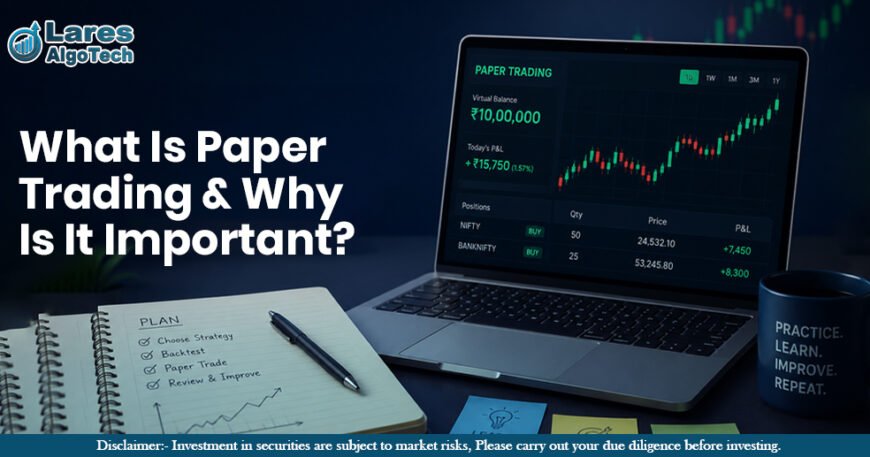
Paper trading allows an individual to practice buying and selling financial instruments using virtual money instead of real capital. It creates a simulated market environment where traders can understand order execution, test strategies, develop risk-management rules, and review their decisions without facing an actual financial loss.
However, paper trading should not be treated as a shortcut to guaranteed success. A strategy that performs well in a simulator may behave differently in the live market because of slippage, liquidity, transaction costs, and emotional pressure. Its real purpose is to help traders build a structured process before committing capital.
This guide explains what paper trading is, how it works, why it is important, and how traders can use it effectively.
What Is Paper Trading?
Paper trading is the practice of simulating trades without using real money. A trader selects an instrument, decides on an entry price, places a virtual order, and tracks the trade as if it were executed in the live market.
The term originated when traders recorded hypothetical trades on paper. Today, most paper trading is done through digital simulators, virtual trading applications, or demo accounts that use live or delayed market data.
A typical paper trading account provides virtual capital that can be used to practice trading in instruments such as
- Equity shares
- Exchange-traded funds
- Futures
- Options
- Commodities
- Currencies
The availability of instruments depends on the simulator being used.
For example, a paper trading platform may give a user ₹500,000 in virtual funds. The user can create a watchlist, analyze a stock, place a simulated buy order, add a stop-loss, and monitor the position. Any resulting profit or loss is virtual and does not affect the user’s actual finances.
In simple terms, paper trading is a rehearsal for live trading.
How Does Paper Trading Work?
The basic process is similar to placing an actual market order:
The trader creates a virtual trading account.
The platform allocates a fixed amount of simulated capital.
The trader selects a stock, index, future, or option contract.
An order type, quantity, entry price, stop-loss, and target are selected.
The simulator records or executes the virtual order.
The trader monitors the position and closes it according to the strategy.
The result is recorded in a trading journal for review.
Some simulators use live market prices, while others may use delayed data. Advanced platforms may also simulate brokerage, taxes, slippage, and other execution costs. These details are important because unrealistic assumptions can make a weak strategy appear profitable.
Paper trading can also be performed manually using a spreadsheet. A trader can record the instrument, entry time, entry price, quantity, stop-loss, target, exit price, and reason for taking the trade. Although this method is less automated, it can encourage detailed analysis and disciplined record-keeping.
A Simple Paper Trading Example
Suppose a trader has virtual capital of ₹100,000 and wants to test a breakout strategy.
The trader identifies a hypothetical stock trading at ₹250 and sets the following plan:
- Entry price: ₹250
- Stop-loss: ₹245
- Target price: ₹260
- Risk per share: ₹5
- Maximum account risk: 1%, or ₹1,000
- Position size: 200 shares
The position size is calculated by dividing the maximum permitted loss by the risk per share:
₹1,000 ÷ ₹5 = 200 shares
If the price reaches ₹260, the simulated gross profit is ₹2,000. If the stop-loss at ₹245 is triggered, the simulated loss is ₹1,000, excluding costs and slippage.
The objective is not merely to see whether the trade wins. The trader should examine whether the entry followed the strategy, the position size respected the risk limit, and the exit was executed according to the original plan.
That evaluation makes paper trading useful as a learning process.
Why Is Paper Trading Important?
It Helps Beginners Understand Market Mechanics
A new trader may know the difference between buying and selling but still be unfamiliar with practical details such as market orders, limit orders, stop-loss orders, bid-ask spreads, option premiums, and margin requirements.
Virtual trading allows beginners to explore these concepts without placing real funds at risk. Regular practice can make the transition from theoretical learning to platform usage more manageable.
It Allows Strategies to Be Tested
A trading idea should not be judged after one or two successful trades. Paper trading helps traders apply the same rules across multiple market sessions and assess whether the strategy behaves consistently.
For example, a trader can test whether a moving-average crossover works better in trending markets than in sideways markets. The results may reveal frequent false signals, unsuitable stop-loss levels, or poor risk-to-reward characteristics.
The findings can then be used to refine the rules before live implementation.
It Encourages Risk-Management Discipline
Risk management is one of the most important parts of trading. Paper trading gives users an opportunity to practice:
- Position sizing
- Stop-loss placement
- Daily loss limits
- Risk-to-reward ratios
- Maximum exposure
- Capital allocation
- Exit discipline
This is especially relevant in leveraged segments such as futures and options. According to SEBI’s latest profitability study, published in August 2026, a significant majority of individual equity-derivatives traders continued to incur losses. Reported data showed that 87.7% of individual traders lost money during FY26. These findings reinforce the need for education, controlled risk, and realistic expectations before participating in complex products. SEBI’s FY25–FY26 profitability study, Reuters report.
It Builds a rule-based trading process.
Without a written plan, traders may enter positions because of market noise, social media tips, or fear of missing out. Paper trading encourages them to define specific conditions before taking a trade.
A structured plan may answer the following:
- What market condition is required?
- What is the exact entry signal?
- Where will the stop-loss be placed?
- How will position size be calculated?
- When will profit be booked?
- Under what condition will the trade be avoided?
Repeatedly following these rules helps convert a general idea into a measurable trading system.
It Supports Forward Testing
Backtesting evaluates how a strategy might have performed using historical data. Paper trading, also known as forward testing in some contexts, observes how the same strategy behaves as the market moves in real time.
Forward testing may expose issues that historical analysis overlooks, including:
- Signals that appear too late
- Rapid price movements
- Low liquidity
- Wide bid-ask spreads
- Missed trading opportunities
- Operational delays
- Difficulty following multiple instruments
For algorithmic traders, paper trading can also help verify signal generation, order logic, position sizing, and risk rules before a strategy is considered for controlled live deployment.
It Helps Traders Study Different Market Conditions
A strategy may perform well during a strong trend but struggle during a sideways or volatile market. A sufficiently long paper trading period lets traders observe how their rules respond to different conditions.
This helps prevent a common mistake: assuming that a strategy is reliable merely because it worked during one favorable week.
It Reduces the Cost of Early Mistakes
Mistakes are a natural part of learning. Beginners may select the wrong quantity, misunderstand an order type, move a stop-loss impulsively, or trade outside their defined setup.
In paper trading, these errors do not create direct financial losses. They can instead be identified, documented, and corrected before actual capital is involved.
Paper Trading vs Live Trading
| Factor | Paper Trading | Live Trading |
| Capital | Virtual funds | Real funds |
| Financial risk | No direct monetary loss | Capital can be lost |
| Emotional pressure | Usually limited | Fear, greed and stress can affect decisions |
| Order execution | Simulated | Depends on liquidity and market conditions |
| Slippage | May be absent or estimated | Can affect actual entry and exit prices |
| Transaction costs | May not be fully included | Brokerage, taxes and charges apply |
| Market impact | Not applicable | Larger orders may influence execution |
| Primary purpose | Learning and strategy testing | Actual market participation |
Paper trading can improve preparation, but it cannot completely reproduce the experience of live trading.
Limitations of Paper Trading
Unrealistic Order Execution
A simulator may assume that every order is filled at the selected price. In the live market, an order may be partially filled, executed at a different price, or remain pending because of insufficient liquidity.
Limited Emotional Involvement
Losing ₹10,000 in virtual capital does not create the same emotional response as losing ₹10,000 of real money. Traders may take larger positions, ignore stop-losses, or enter low-quality trades because the consequences are not real.
Incomplete Trading Costs
Some virtual trading platforms do not accurately calculate brokerage, securities transaction tax, exchange charges, GST, stamp duty, and other costs. Frequent strategies may look profitable before costs but become ineffective after realistic expenses are included.
Overconfidence After a Short Winning Period
A few profitable paper trades are not sufficient to prove that a strategy has an edge. Short-term performance may be caused by favorable market conditions or chance.
Data and Technology Differences
Delayed prices, simplified option-chain data, or unrealistic spreads can affect results. Algorithmic strategies may also face latency, connectivity, and order-rejection issues when moved from a test environment to a live system.
These limitations do not make paper trading ineffective. They simply mean that its results must be interpreted carefully.
How to Start Paper Trading
Step 1: Define the Learning Objective
Decide what you want to practice. The objective could be understanding order types, testing an intraday setup, studying options behavior, or learning position sizing.
Step 2: Choose One Market Segment
Beginners should generally focus on one segment or instrument category at a time. Testing too many unrelated markets can make the results difficult to evaluate.
Step 3: Use Realistic Virtual Capital
Set the virtual account balance close to the amount you could responsibly allocate in the future. Practicing with ₹50 lakh in virtual money is not useful if the eventual live capital is expected to be ₹1 lakh.
Step 4: Write Clear Entry and Exit Rules
Avoid vague conditions such as “buy when the stock looks strong.” Define measurable rules covering the setup, entry, stop-loss, target, position size, and maximum holding period.
Step 5: Account for Trading Costs
Where possible, include estimated brokerage, statutory charges, bid-ask spread, and slippage. This creates a more realistic view of net performance.
Step 6: Maintain a Trading Journal
Record the following details for every virtual trade:
- Date and time
- Instrument
- Market condition
- Entry and exit
- Quantity
- Stop-loss and target
- Reason for the trade
- Gross and net result
- Whether the rules were followed
- Lessons learned
Screenshots can also help traders review chart patterns and execution decisions later.
Step 7: Evaluate a Meaningful Sample
Do not judge a strategy after five trades. The appropriate sample depends on the strategy’s frequency, but the test should cover enough trades and different market conditions to reveal recurring strengths and weaknesses.
Useful metrics include win rate, average profit, average loss, maximum drawdown, risk-to-reward ratio, consecutive losses, and rule adherence.
Step 8: Move to Live Trading Gradually
Successful paper trading does not justify immediately taking large positions. If a trader chooses to enter the live market, the transition should be gradual, with smaller position sizes and predefined risk limits.
Common Paper Trading Mistakes
Paper trading becomes less useful when traders treat it like a game. Common mistakes include:
- Taking trades without a written setup
- Using unrealistic virtual capital
- Ignoring transaction costs and slippage
- Changing strategy rules after every loss
- Testing only during favourable market conditions
- Increasing position size to recover a virtual loss
- Recording profits but not analysing mistakes
- Moving to live trading after only a few winning trades
The purpose is to test discipline and decision-making—not to create the highest possible virtual account balance.
How Long Should You Practice Paper Trading?
There is no universal time period that suits every trader. Instead of focusing only on the number of days, evaluate whether you have:
- Tested a meaningful number of trades
- Experienced different market conditions
- Followed the same rules consistently
- Included realistic costs
- Understood the strategy’s drawdowns
- Developed a repeatable journaling process
Paper trading may also remain useful after a person begins live trading. New setups, order types, and algorithmic strategies can continue to be evaluated in a simulated environment before real-world use.
Is Paper Trading Suitable for Every Trader?
Paper trading can be useful for beginners, active traders, investors learning platform functions, and algorithmic traders validating execution logic. Experienced traders may also use it when exploring a new market segment or significantly changing an existing strategy.
However, it should form part of a broader learning process that includes market education, risk management, regulatory awareness, and realistic financial planning.
Conclusion
Understanding what paper trading is is an important step for anyone preparing to participate in the financial markets. It provides a controlled environment for learning order execution, testing strategies, practicing position sizing, and building a disciplined trading process without immediately exposing real capital.
Its value, however, depends on how seriously it is used. Virtual trades should follow realistic rules, include estimated costs, and be recorded in a detailed journal. Traders must also recognize that simulated performance does not guarantee comparable live-market results.
When transitioning from practice to actual market participation, working with a regulated and technology-focused broker can help create a more structured trading experience. Lares Algotech India Private Limited is a SEBI-registered stock broker under registration number INZ000316732 and a member of NSE, BSE, and MCX. Lares Algotech focuses on transparent, efficient, and technology-driven trading solutions for market participants. Learn more about Lares Algotech.
Trading and investing in securities are subject to market risk. Paper trading results, backtesting data, and historical performance do not guarantee future outcomes. Investors should understand the products, costs, and risks before participating in the market.
FAQ’s
What is paper trading in simple words?
Paper trading is a method of practicing stock market trades using virtual money. It allows users to simulate buying and selling without risking actual capital.
Is paper trading legal in India?
Yes, practicing trades through a simulator or recording hypothetical trades is legal. However, paper trading is educational and does not constitute actual exchange execution. Users should choose reliable platforms and avoid sharing money or credentials with unverified applications.
Can beginners use paper trading?
Yes. Beginners can use it to understand order types, charts, stop-losses, position sizing, and trading-platform functions before considering live participation.
Can I make real money through paper trading?
No. Profits and losses generated in a paper trading account are virtual. Real money is neither invested nor earned.
Is paper trading completely risk-free?
It does not involve direct financial risk because real capital is not used. However, relying on unrealistic results or developing poor habits can create indirect risk when transitioning to live trading.
What is the difference between backtesting and paper trading?
Backtesting applies strategy rules to historical data. Paper trading tests the strategy as the market develops in real time using virtual capital. Both are useful, but neither guarantees live performance.
Does successful paper trading guarantee profitable live trading?
No. Live trading includes emotional pressure, slippage, transaction costs, liquidity constraints, and real execution risks that may not be fully reflected in a simulator.
What should I record in a paper trading journal?
Record the instrument, entry, exit, quantity, stop-loss, target, market condition, reason for the trade, estimated costs, result, rule adherence, and key lesson from every trade.