
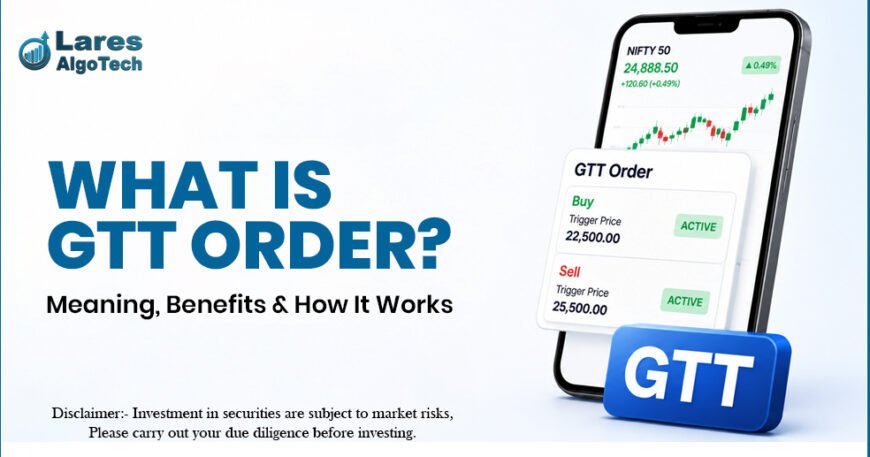
What Is a GTT Order and How Does It Work?
In today’s fast-moving stock market, investors and traders often struggle to monitor price movements throughout the trading session. Whether you’re a working professional, business owner, or long-term investor, watching the market every minute is rarely practical. Missing the right buying or selling opportunity can directly impact your investment decisions.
This is where a GTT Order becomes valuable.
A GTT (Good Till Triggered) Order allows investors to set a predefined trigger price for buying or selling a stock. Once the market reaches that trigger level, the trading platform automatically places the order according to your instructions. This helps traders execute planned strategies without constantly tracking the market.
Unlike regular day orders that expire if not executed during the trading session, GTT Orders are designed to remain active until the trigger condition is met or until they expire based on your broker’s policy.
For investors who believe in disciplined investing and rule-based trading, GTT Orders provide convenience, automation, and improved decision-making.
In this detailed guide, you’ll learn everything about GTT Order, including how it works, its advantages, limitations, comparisons with other order types, practical examples, and best practices for using it effectively.
What Is a GTT Order?
A GTT Order (Good Till Triggered Order) is an advanced order type that allows investors to place an instruction that remains pending until a specified trigger price is reached.
Instead of manually checking stock prices every day, investors can simply define:
- Trigger Price
- Buy or Sell Order
- Quantity
- Limit Price (if applicable)
Once the stock reaches the trigger price, the trading platform sends the order to the exchange for execution.
In simple words:
A GTT Order helps automate your planned trades without requiring continuous market monitoring.
For example:
Suppose Reliance Industries is currently trading at ₹1,600, but you only want to buy it if the price falls to ₹1,500.
Instead of watching the market every day, you place a GTT Order with a trigger price of ₹1,500. If the stock reaches this level, the order is automatically placed.
Why Was the GTT Order Introduced?
Traditional trading requires investors to monitor the market continuously.
Common challenges include:
- Missing buying opportunities
- Missing profit booking
- Emotional decision-making
- Busy work schedules
- Frequent market fluctuations
GTT Orders solve these challenges by allowing traders to automate planned entries and exits.
How Does a GTT Order Work?
The working process is straightforward.
Step 1: Select the Stock
Choose the stock you wish to buy or sell.
Example:
TCS
Step 2: Set the Trigger Price
Decide the price at which you want your order to become active.
Example:
Current Price:
₹3,850
Trigger Price:
₹3,700
Step 3: Set Order Details
Specify:
- Quantity
- Order Price
- Buy or Sell
- Order Type
Step 4: Submit the GTT Order
The order remains stored in your broker’s system until the trigger price is reached.
Step 5: Market Reaches Trigger Price
Once the market touches your trigger price, the order is automatically sent to the exchange.
Step 6: Order Execution
If matching buyers or sellers are available, your order gets executed.
If sufficient liquidity is unavailable or the price moves rapidly, execution may not occur even after the trigger is hit.
Types of GTT Orders
- Single Trigger GTT Order
A single-trigger GTT is used when you want to buy or sell a stock at one specific trigger price.
Example:
Current Price:
₹950
Desired Buy Price:
₹900
Trigger:
₹900
Once ₹900 is reached, your order becomes active.
- Two-Trigger GTT (One Cancels the Other – OCO)
This type allows investors to set both:
- Target Price
- Stop Loss Price
If one condition executes, the other is automatically cancelled.
Example:
Buy Price:
₹1,000
Target:
₹1,120
Stop Loss:
₹950
If ₹1,120 is reached first, the stop-loss order is cancelled automatically.
Likewise, if ₹950 is reached first, the target order is cancelled.
This feature helps automate both profit booking and risk management.
Key Features of GTT Orders
A GTT Order offers several practical features that make investing more convenient.
Some of its important features include:
- Automatic order placement
- No need for continuous market tracking
- Suitable for long-term investing
- Helps maintain trading discipline
- Supports predefined entry and exit strategies
- Reduces emotional trading
- Saves time
- Can be used for buying as well as selling
Benefits of Using GTT Orders
Saves Time
Investors no longer need to check stock prices every few minutes.
The platform automatically tracks the trigger price on their behalf.
Reduces Emotional Trading
Many investors make impulsive decisions due to fear or greed.
GTT Orders execute pre-planned strategies rather than emotional reactions.
Better Risk Management
Investors can use trigger-based exits to limit losses and secure profits.
Ideal for Working Professionals
People with full-time jobs often cannot monitor markets throughout the day.
GTT Orders help them participate in the market without constant supervision.
Better Investment Discipline
Successful investing depends on following predefined strategies.
GTT Orders encourage systematic investing rather than random decisions.
Convenient for Long-Term Investors
Long-term investors often wait for attractive buying opportunities.
Instead of watching prices daily, they can simply set a trigger.
Who Should Use GTT Orders?
GTT Orders are suitable for a wide range of market participants, including:
- Long-term investors
- Swing traders
- Positional traders
- Beginners
- Working professionals
- Business owners
- Investors managing multiple stocks
- Traders who follow rule-based strategies
Real-Life Example of a GTT Order
Suppose Infosys is trading at ₹1,720.
You believe it is a good investment only if the price falls to ₹1,650.
You place a GTT Order with:
- Trigger Price: ₹1,650
- Buy Price: ₹1,650
- Quantity: 20 Shares
Ten days later, the market corrects, and Infosys touches ₹1,650.
Your broker’s platform automatically places your buy order.
If matching sellers are available, your shares are purchased without requiring you to manually enter the order.
GTT Order vs Limit Order
| Feature | GTT Order | Limit Order |
| Validity | Remains active until trigger or expiry (broker-dependent) | Usually valid only for the selected order validity |
| Trigger Price | Yes | No |
| Automatic Monitoring | Yes | No |
| Manual Placement Required | No | Yes |
| Suitable For | Planned future trades | Immediate order placement |
| Market Tracking | Automatic | Manual |
GTT Order vs Stop Loss Order
| Feature | GTT Order | Stop Loss Order |
| Purpose | Automated future entry/exit | Limit downside risk |
| Trigger Required | Yes | Yes |
| Used For | Buying or Selling | Mainly protection after entering a position |
| Validity | Longer duration (broker-dependent) | Based on exchange order validity |
| Suitable For | Investors and swing traders | Active traders |
GTT Order vs Market Order
| Feature | GTT Order | Market Order |
| Execution | After trigger | Immediate |
| Price Control | Yes | No |
| Automation | Yes | No |
| Market Monitoring | Automatic | Manual |
| Best For | Planned investing | Instant execution |
Advantages of GTT Orders
Some major advantages include:
- Saves valuable time
- Better trade planning
- Reduces emotional decisions
- Convenient for busy investors
- Supports systematic investing
- Automates buy and sell decisions
- Helps improve trading discipline
- Suitable for long-term strategies
Limitations of GTT Orders
Although useful, GTT Orders also have certain limitations.
Price Gaps
If the market opens significantly above or below the trigger price, execution may differ from expectations.
Execution Is Not Guaranteed
Reaching the trigger does not necessarily guarantee execution. The order still depends on available liquidity and market conditions.
Broker Policies Differ
Validity periods, supported segments, and features vary between brokers.
Corporate Actions
Stock splits, bonuses, or other corporate actions may affect pending GTT Orders.
Common Mistakes to Avoid
Many beginners misuse GTT Orders.
Avoid these mistakes:
- Setting unrealistic trigger prices
- Ignoring market trends
- Forgetting to review pending orders
- Using GTT for highly volatile events
- Not considering liquidity
- Assuming execution is guaranteed
- Ignoring broker-specific validity rules
Best Practices for Using GTT Orders
To use GTT Orders effectively:
- Research the stock before placing orders.
- Set realistic trigger prices based on technical or fundamental analysis.
- Combine GTT Orders with proper risk management.
- Review pending GTT Orders regularly.
- Avoid placing triggers too close to market noise.
- Diversify your portfolio.
- Stay informed about major market events and corporate announcements.
When Should You Use a GTT Order?
A GTT Order is especially useful when you want to:
- Buy quality stocks during market corrections
- Book profits at predefined levels
- Plan long-term investments
- Enter swing trades
- Protect profits using predefined exit levels
- Invest while managing a busy work schedule
- Follow a disciplined investment strategy
When Should You Avoid Using GTT Orders?
Consider avoiding GTT Orders during:
- Extremely volatile market conditions
- Major corporate announcements
- Election result days
- Union Budget announcements
- Stocks with very low trading volumes
- Intraday trading strategies that require immediate execution
Why GTT Orders Are Becoming Popular in India
India has witnessed a significant rise in retail investing over the past few years.
Several factors have contributed to the growing popularity of GTT Orders:
- Increasing adoption of online trading platforms
- Growing awareness of rule-based investing
- More working professionals participating in equity markets
- Demand for automation and convenience
- Improved mobile trading technology
- Better access to advanced order types through modern brokerage platforms
As more investors focus on disciplined and technology-enabled investing, GTT Orders continue to gain traction.
How Lares Algotech Supports Smarter Trading
Modern investing requires reliable technology, secure infrastructure, and efficient execution.
As a SEBI-registered stock broker, Lares Algotech provides traders and investors with technology-driven trading solutions designed to support informed decision-making.
Depending on the services available through the platform, investors can benefit from features such as:
- Advanced trading platform
- Equity, F&O, Currency, and Commodity trading access
- Fast order execution
- Secure trading environment
- Smart order management capabilities
- Dedicated customer support
- Technology-focused trading experience
Before using any advanced order type, investors should understand the platform’s specific features, supported order types, and applicable terms.
Conclusion
A GTT Order is one of the most useful tools for investors who prefer disciplined, rule-based investing. Instead of constantly monitoring market movements, traders can define their preferred buying or selling price and let the trading platform monitor the market on their behalf.
Whether you’re a beginner learning the basics of the stock market or an experienced investor managing a diversified portfolio, GTT Orders can help simplify trade execution, reduce emotional decision-making, and save valuable time.
However, it’s important to remember that a triggered GTT Order does not guarantee execution. Factors such as market liquidity, price gaps, and broker-specific policies can affect the final outcome. Always understand how your broker implements GTT functionality and ensure it aligns with your investment strategy.
When used wisely alongside sound research, proper risk management, and a well-defined financial plan, GTT Orders can become a valuable part of your long-term investing approach.
FAQs
What is a GTT Order?
A GTT (Good Till Triggered) Order is an instruction that remains active until a specified trigger price is reached, after which the order is sent to the exchange for execution.
What does GTT stand for?
GTT stands for Good Till Triggered.
Is a GTT Order suitable for beginners?
Yes. It is useful for beginners who want to automate planned buy or sell decisions instead of continuously monitoring the market.
Does a GTT Order guarantee execution?
No. The trigger activates the order, but execution still depends on market price, liquidity, and exchange conditions.
Can I cancel or modify a GTT Order?
Most brokers allow users to modify or cancel pending GTT Orders before they are triggered.
Is GTT useful for long-term investors?
Yes. Long-term investors often use GTT Orders to buy quality stocks at preferred price levels or book profits at target prices.
Can GTT Orders be used for selling stocks?
Yes. GTT Orders can be used for both buying and selling, depending on your investment strategy.
Is a GTT Order better than a Limit Order?
They serve different purposes. A GTT Order is useful for future automated execution, while a Limit Order is intended for immediate placement with a specified price.